Home · Sights · The Washington Monument
What you are looking at01
The Washington Monument
The Mall · 15th St
- The shaftFive hundred feet of marble over granite, its walls tapering as they rise to the pyramidion.
- The line in the stoneThe lower third is a lighter shade, marble from different quarries on either side of the pause.
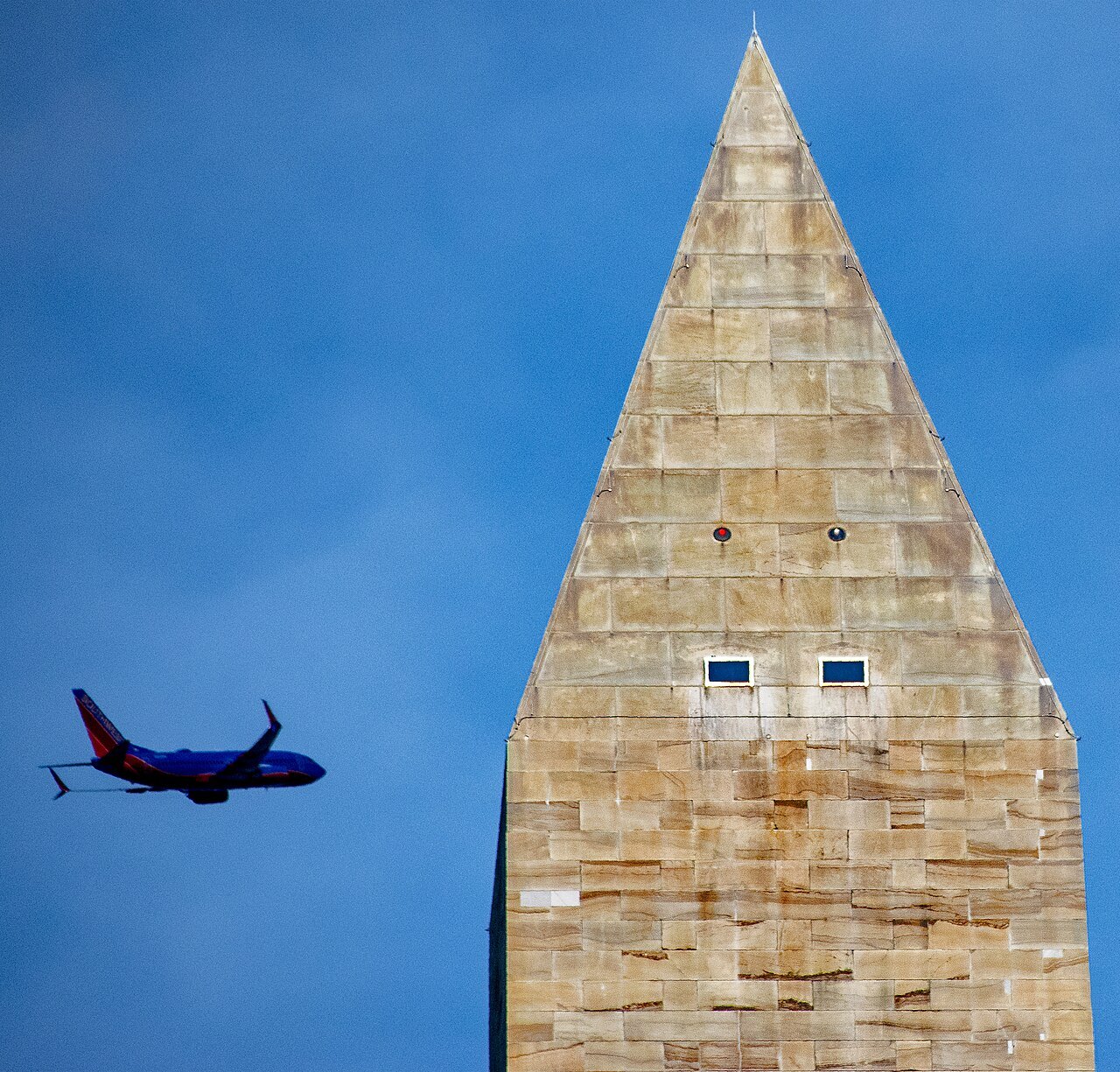
- The observation levelEight windows in the pyramidion, two on each side, reached by elevator.
- The memorial stonesInscribed stones given by states, cities and societies, set into the interior walls.
- The ring of flagsFifty flags, one for each state, on a circle of poles around the base.
- The Jefferson PierA small stone to the west-northwest, where the Monument was meant to stand.
The sight in full02
Reading the place
Why it matters
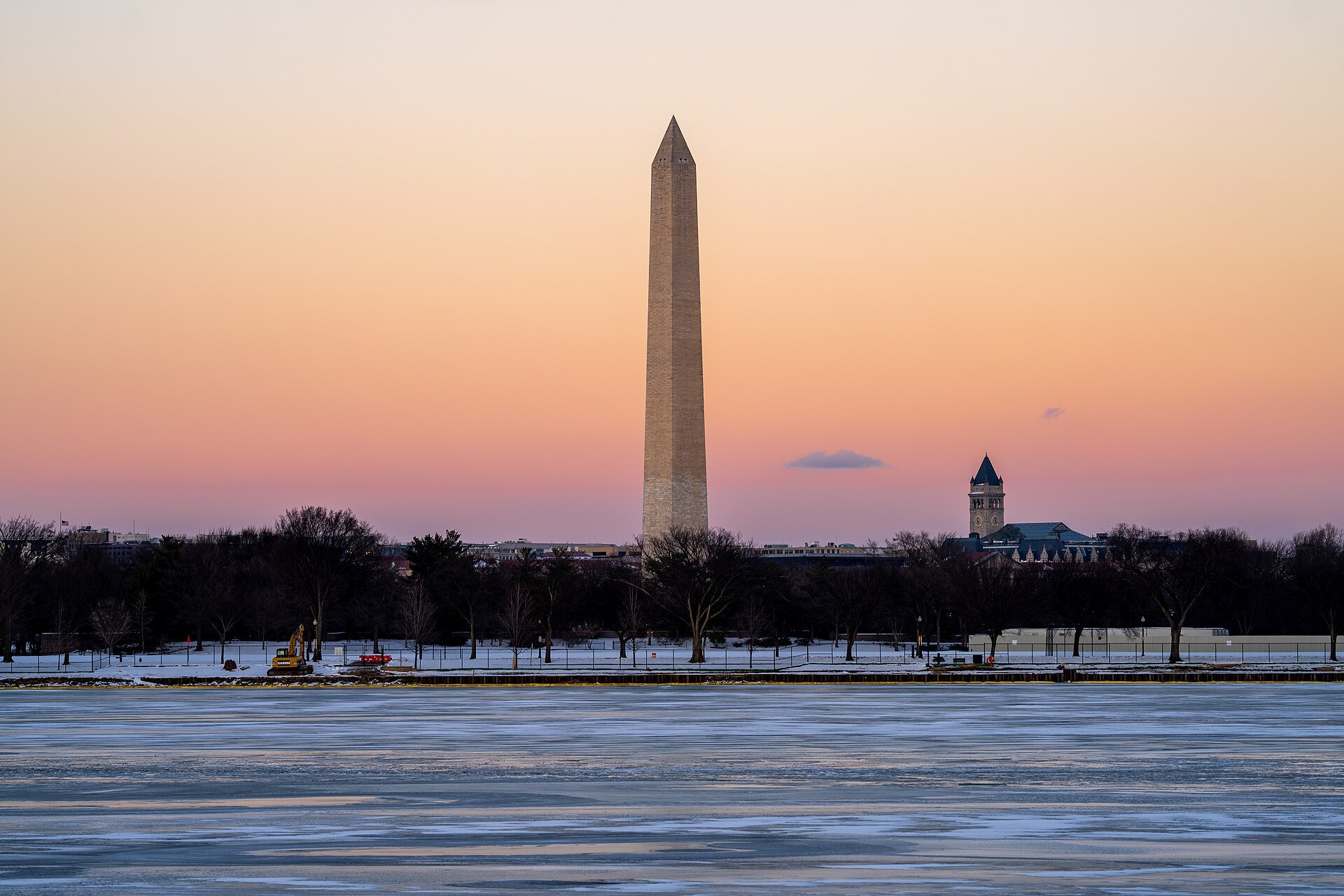
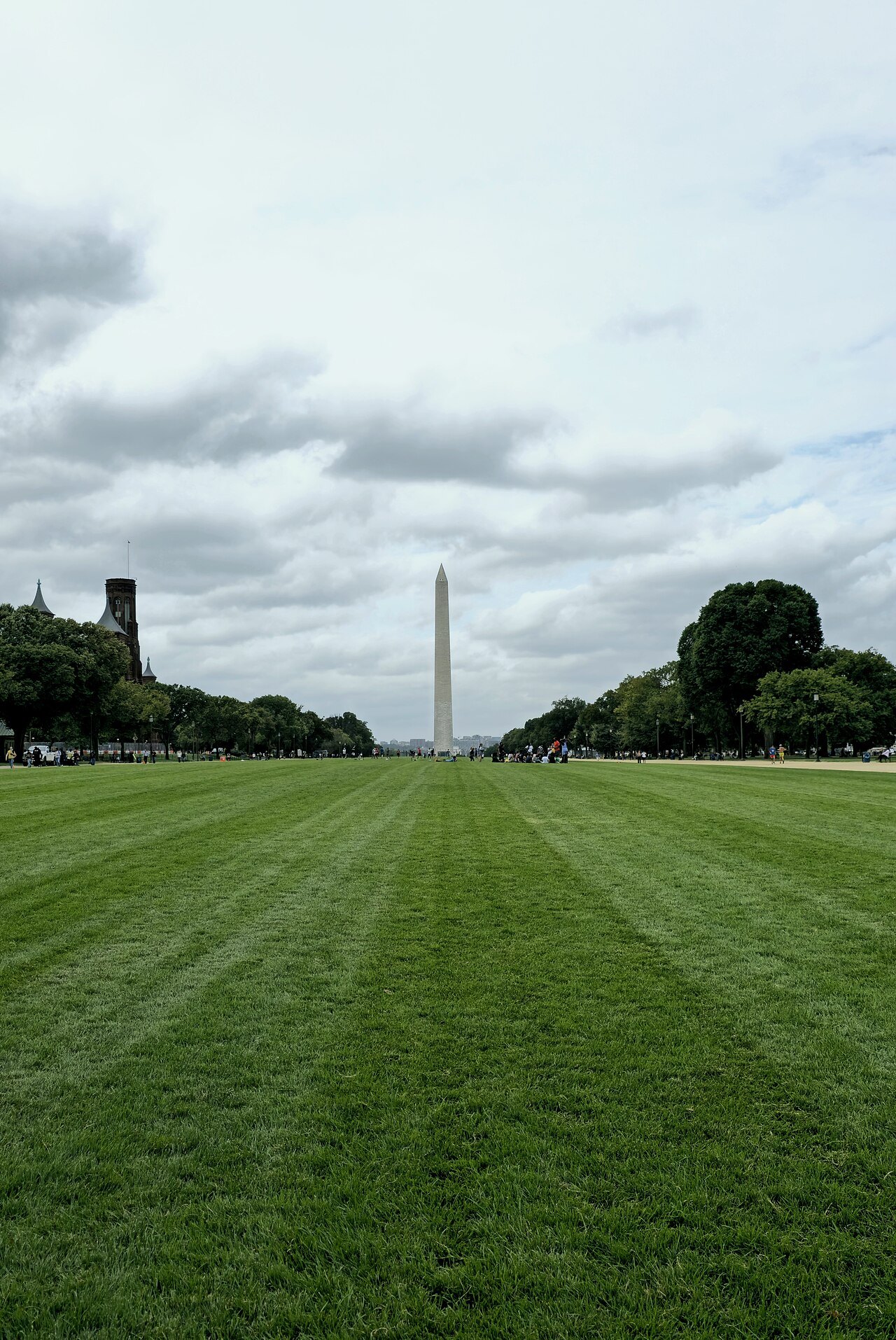
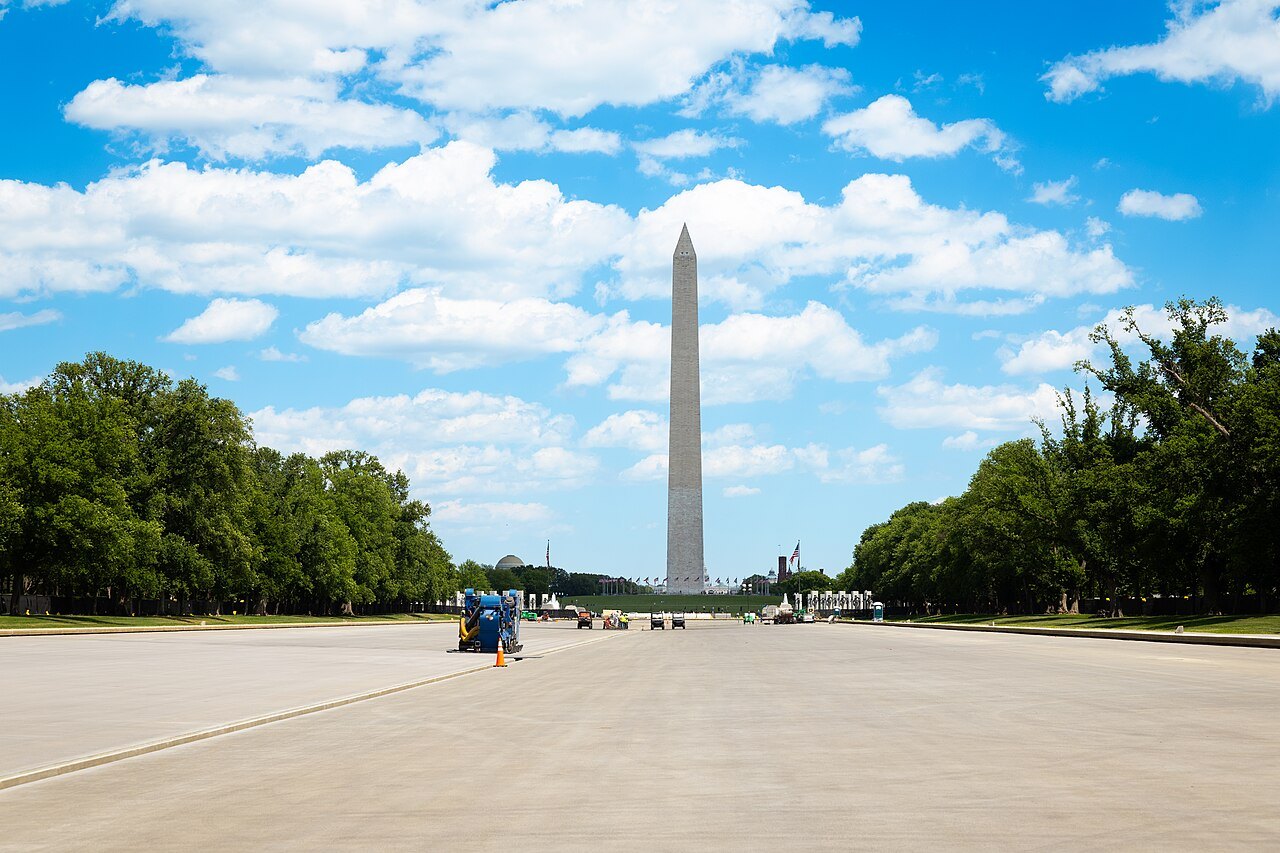
The Washington Monument is the vertical that the whole city is measured against. It is an obelisk of stone about 555 feet tall, a hollow shaft of 500 feet capped by a pyramidion 55 feet high, built to honor George Washington, and it stands near the center of the Mall where the long axis from the Capitol meets the line running south from the White House. From almost anywhere in the monumental core it is in view.
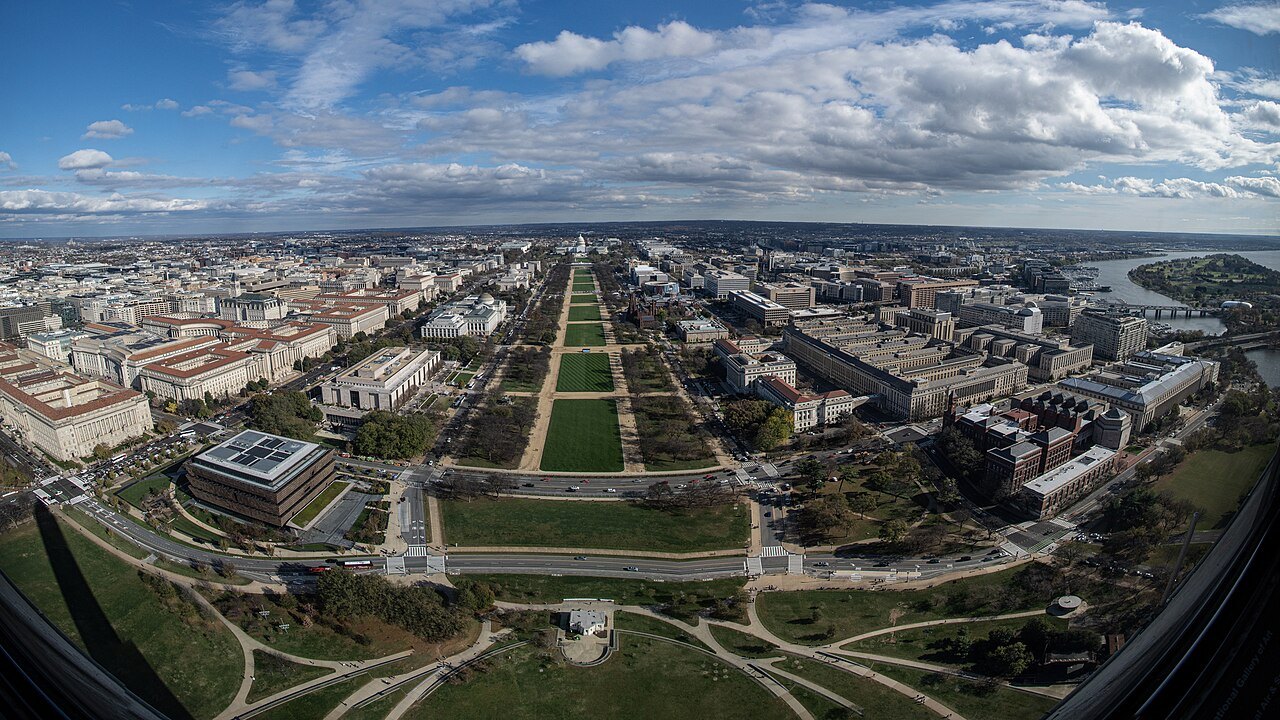
When its stonework was finished in 1884 it was the tallest structure in the world, and it kept that title until 1889, when the Eiffel Tower overtook it. It is still one of the tallest monumental columns anywhere. Washington's height limits on ordinary buildings, which tie a building's height to the width of its street, keep the skyline low around it, so it has no rivals on the horizon (see the plan).
A monument that stopped halfway
The design was by Robert Mills of South Carolina, chosen in 1845. He imagined an obelisk 500 feet high rising from a circular colonnaded temple 250 feet across, for a total of 600 feet. The Washington National Monument Society, which was raising the money privately, decided in April 1848 that it could only afford the obelisk, and the cornerstone was laid on July 4, 1848, by the Freemasons, to whom Washington had belonged.
Work went on until 1854, when the donations ran out at a height of 152 feet. That spring members of the anti-Catholic American Party, the Know-Nothings, stole and destroyed a memorial stone sent by Pope Pius IX, and in 1855 they took control of the society. They added only two courses of rejected masonry before giving the monument back in 1858. Then came the Civil War, and for more than twenty years the stump stood unfinished on the Mall.
Congress took over and building resumed in 1879, under Thomas Lincoln Casey of the Army Corps of Engineers. He simplified Mills's details, dropped the temple altogether and gave the obelisk the proportions of an Egyptian one. The stonework was completed in 1884, the monument was dedicated on February 21, 1885, and it opened to the public on October 9, 1888.
The place it was meant to be
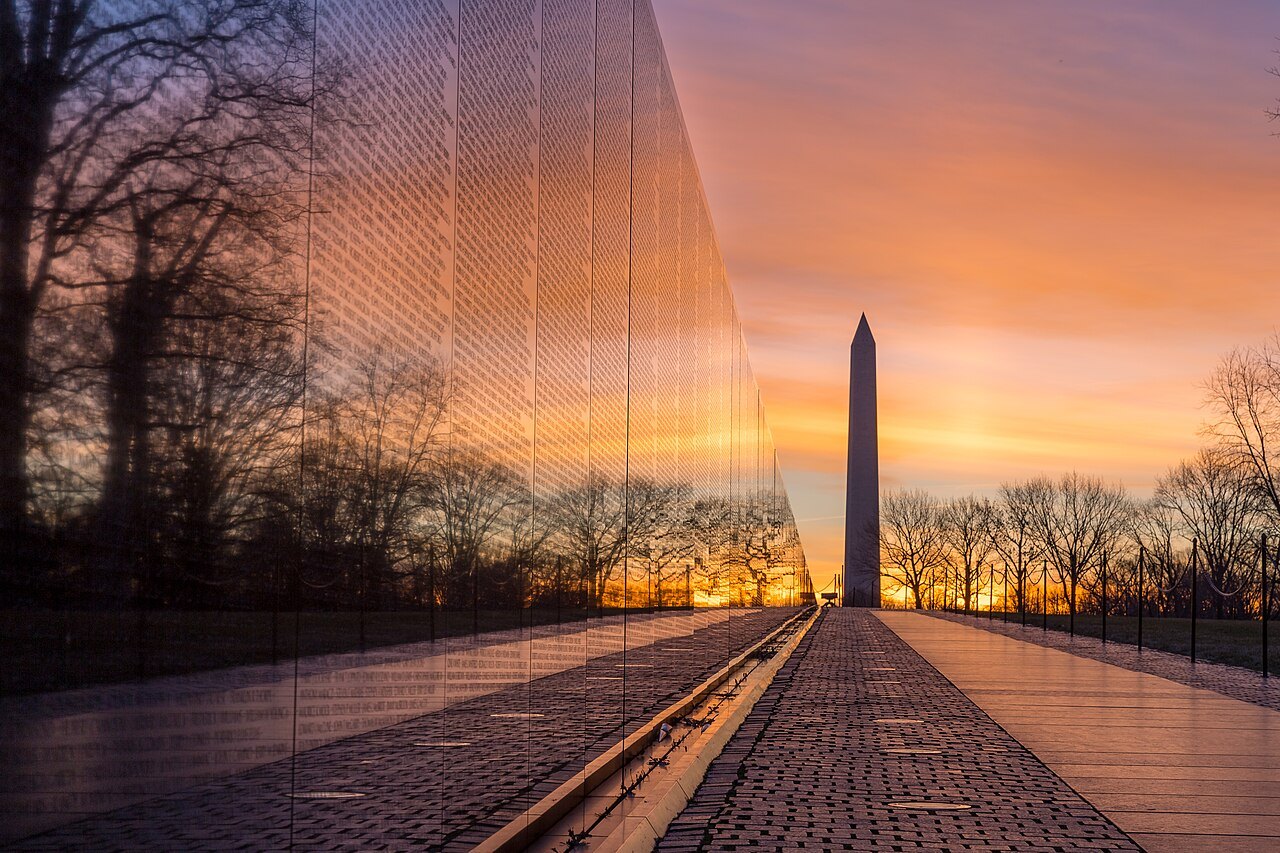
L'Enfant's plan of 1791 put a monument to Washington exactly where the axis west from the Capitol crossed the axis south from the White House. When the builders tested the ground there, it was too unstable to carry so heavy a structure, and the Monument was moved about 390 feet to the east-southeast. A small stone called the Jefferson Pier now marks the intended spot.
The small shift has a long consequence. When the McMillan Plan of 1901 placed the Lincoln Memorial at the west end of the Mall, it set it on the axis of the Capitol and the Monument as built, about one degree south of due west, so the whole Mall runs very slightly askew to the compass. Stand at the Jefferson Pier and you are at the point the plan was drawn around.
What you actually see
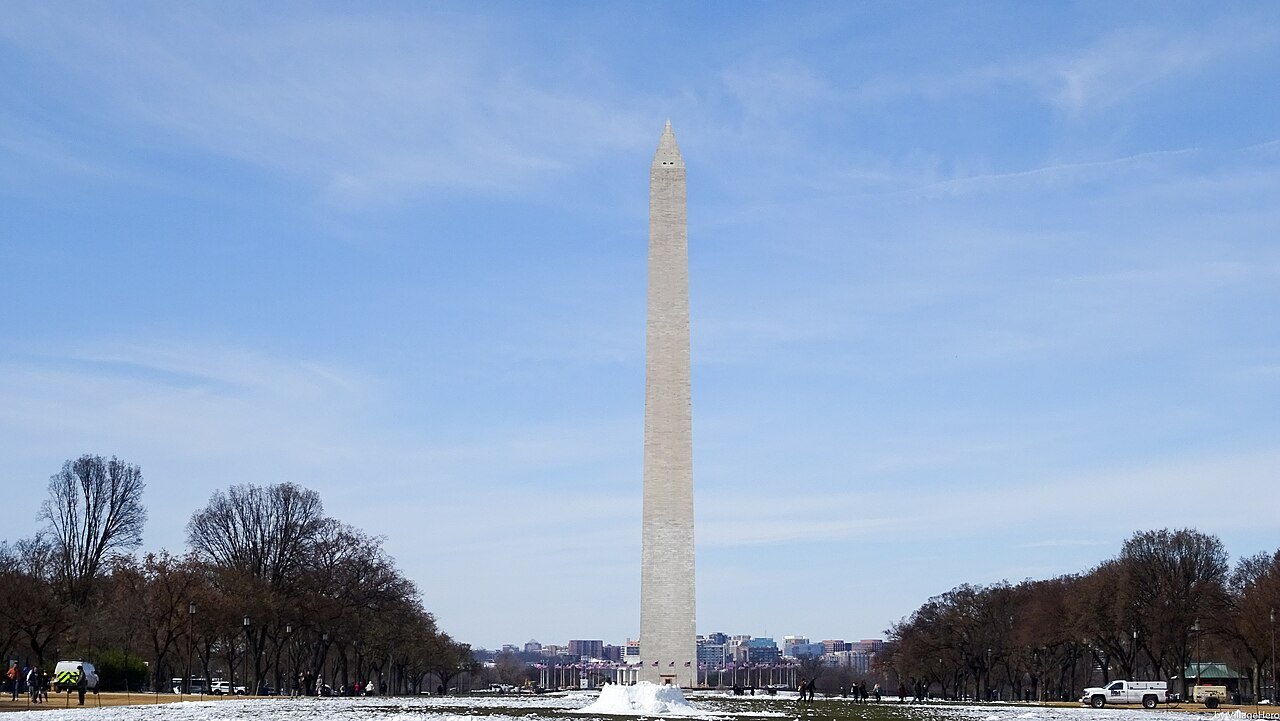
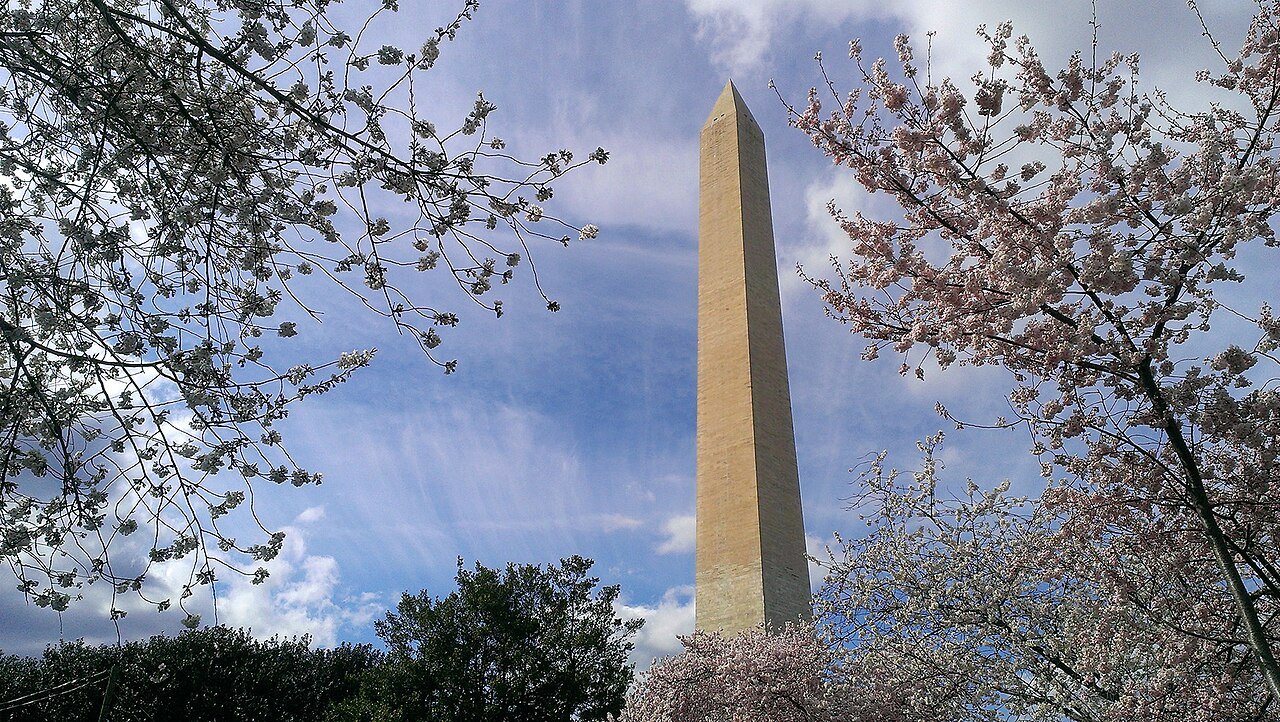
From a distance, look at the shaft about a third of the way up and you will see a change in color: the lower part is a slightly lighter shade than the rest, because the marble came from different quarries before and after the long pause. The outer walls are marble, backed by rough granite and gneiss, and they taper as they rise; the top of the pyramidion is a marble capstone with a small aluminum pyramid at the very apex, inscribed on all four sides.
Around the base, fifty flags fly on a large circle of poles, one for each state. Inside, iron stairs spiral up the walls around a central elevator, and the walls are set with memorial stones given by states, cities, societies and other countries; when construction resumed, Casey found 92 already set into the walls and built in most of the rest during the 1880s. At the top, the pyramidion has eight observation windows, two on each side, and from them you look down the Mall to the Capitol and the Lincoln Memorial, north to the White House and south across the Tidal Basin to the Jefferson Memorial.
How to visit
The grounds, the flags and the base can be seen at any time. Going up requires a ticket for everyone aged two and over, and the National Park Service, which runs the monument, says demand far exceeds supply in spring, summer and fall. Advance tickets are released online through Recreation.gov about thirty days ahead, with a small service charge, and more are released the day before; a limited number of free same-day tickets are handed out each morning at the Washington Monument Lodge on 15th Street, first come, first served, and they usually run out (see booking ahead).
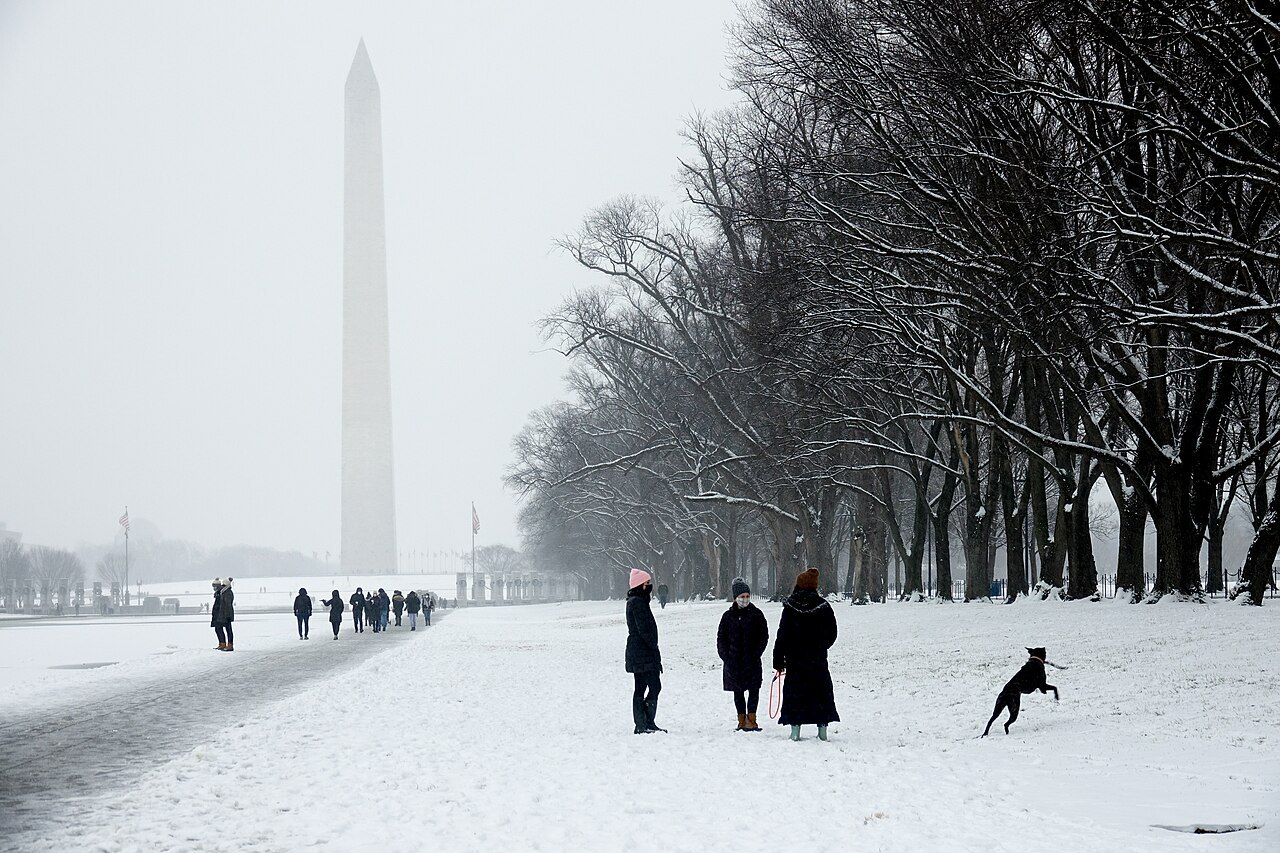
Everyone passes through security screening before entering, and rangers take visitors in small groups at their ticket time; knives, strollers and bulky items are not allowed. There are no restrooms or drinking fountains inside; the nearest restrooms are at the Lodge. The monument can close in high winds and thunderstorms, and tickets for the affected times are then cancelled, so check before you go.
Honest notes
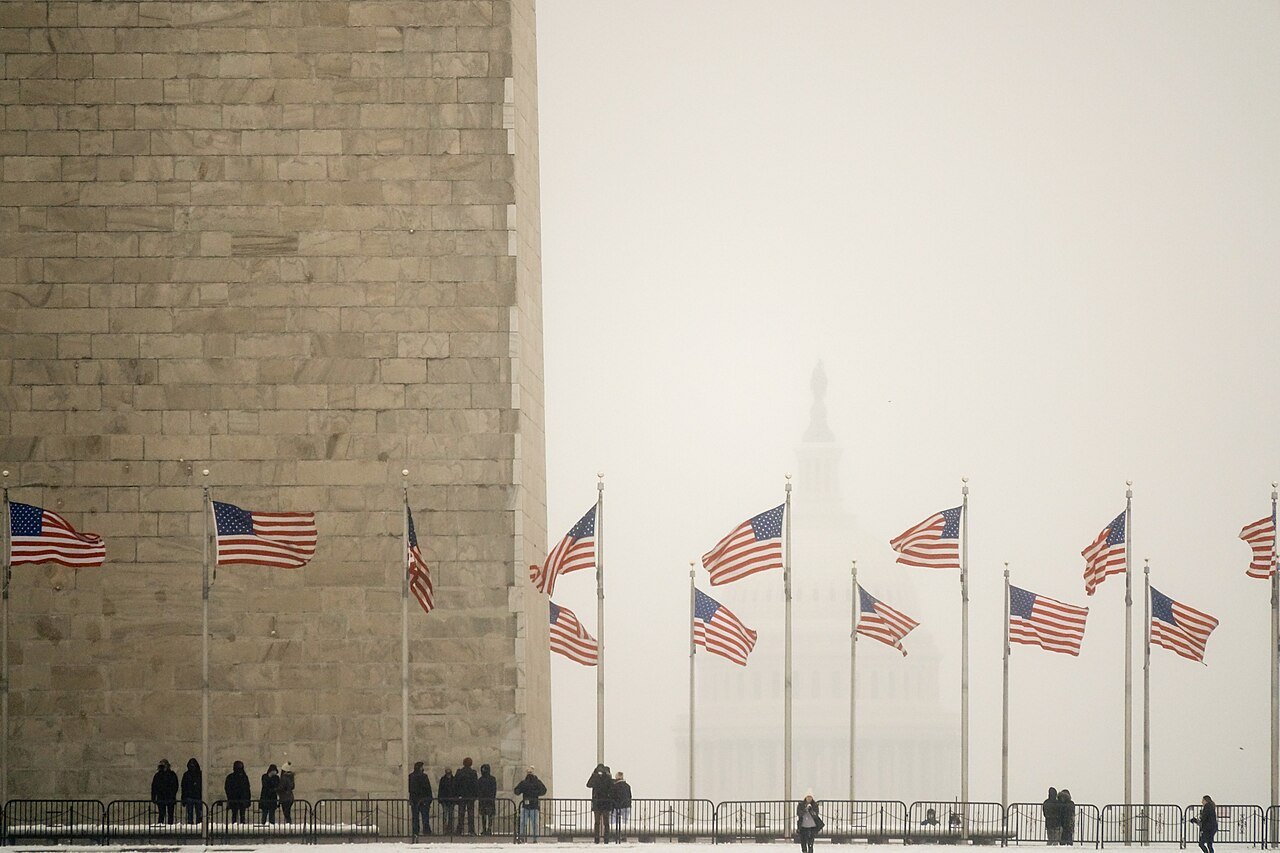
The monument was closed for long periods in recent years: after the Virginia earthquake of 2011 it was shut for repairs until 2014, and it closed again from 2016 to 2019; the elevator had already been replaced once, in a closure that began at the end of 2000. Its height is usually given as 555 feet; the most recent survey, in 2013 and 2014, measured it at just under 555 feet. And it is not quite where the plan put it, which is why the Mall's axis is not quite true to west.
Where to go next03
Nearby
- Nearby · 17th St · Constitution GardensThe World War II, Korean War and Vietnam MemorialsThree memorials to three wars around the Reflecting Pool: an oval of 56 granite pillars and two arches, nineteen steel soldiers crossing a field of juniper, and Maya Lin's black granite walls cut into the ground with more than 58,000 names.Read the page →
- Nearby · Constitution Ave · 14th St NWThe National Museum of African American History and CultureThe Smithsonian's newest museum on the Mall, opened in 2016: a three-tiered bronze-colored corona drawn from a Yoruba crown, and inside it the history of Black America from the Middle Passage to the present, told from the bottom floor up.Read the page →
- Nearby · 1600 Pennsylvania Ave NWThe White House and Lafayette SquareThe house James Hoban designed in 1792, home to every president since John Adams in 1800, burned in 1814 and rebuilt inside its walls in the 1950s, seen best from the square to its north and the Ellipse to its south.Read the page →