THREE MARBLES, A TWENTY-FIVE-YEAR PAUSE AND A LINE YOU CAN SEE FROM THE MALL01
Why is the Washington Monument two colors?
About a third of the way up, the Washington Monument changes shade. The line marks where building stopped in 1854 and started again in 1879, and the stone above it came from different quarries. How it happened and where to see it best.
The answer in full02
Read on
The short answer
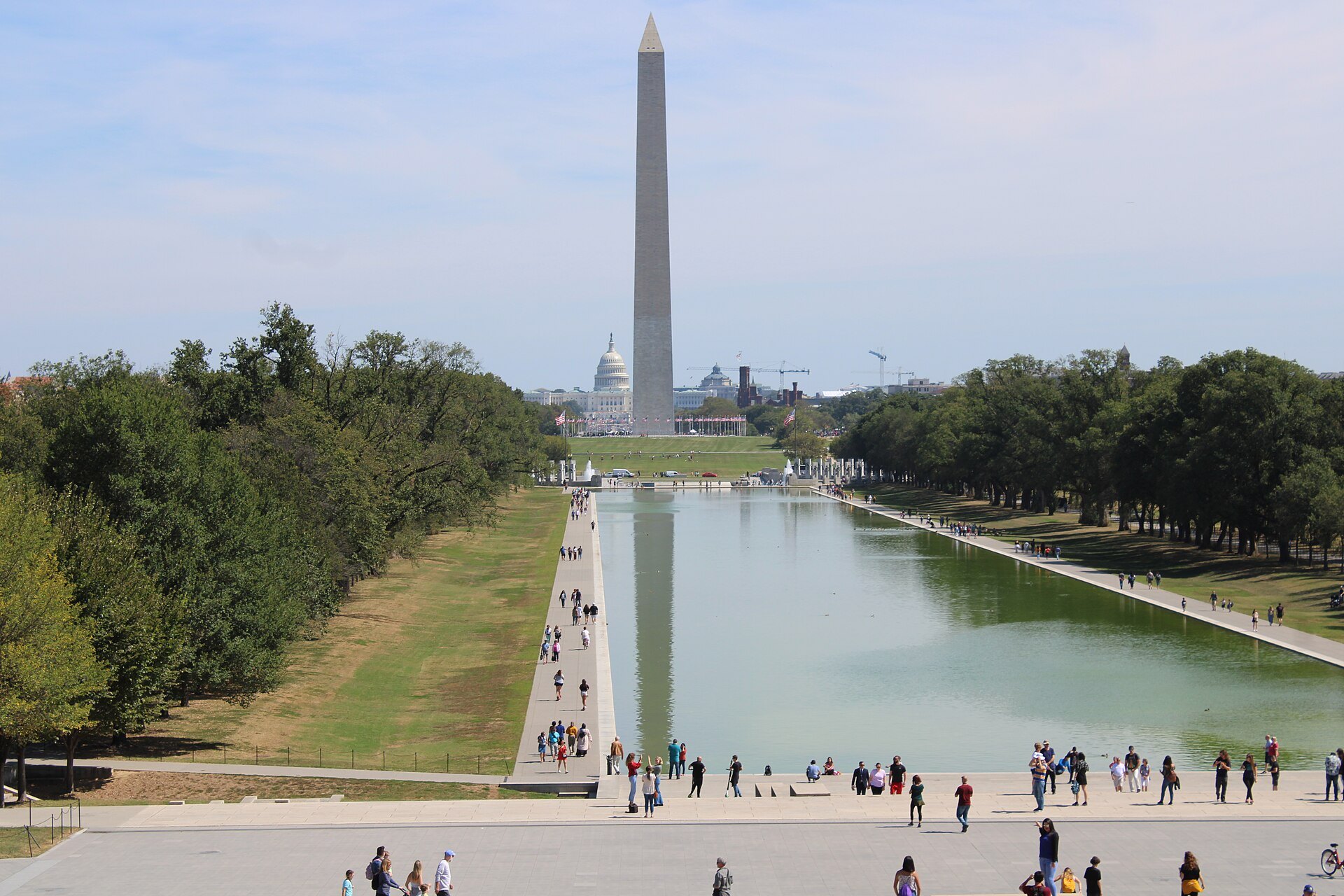
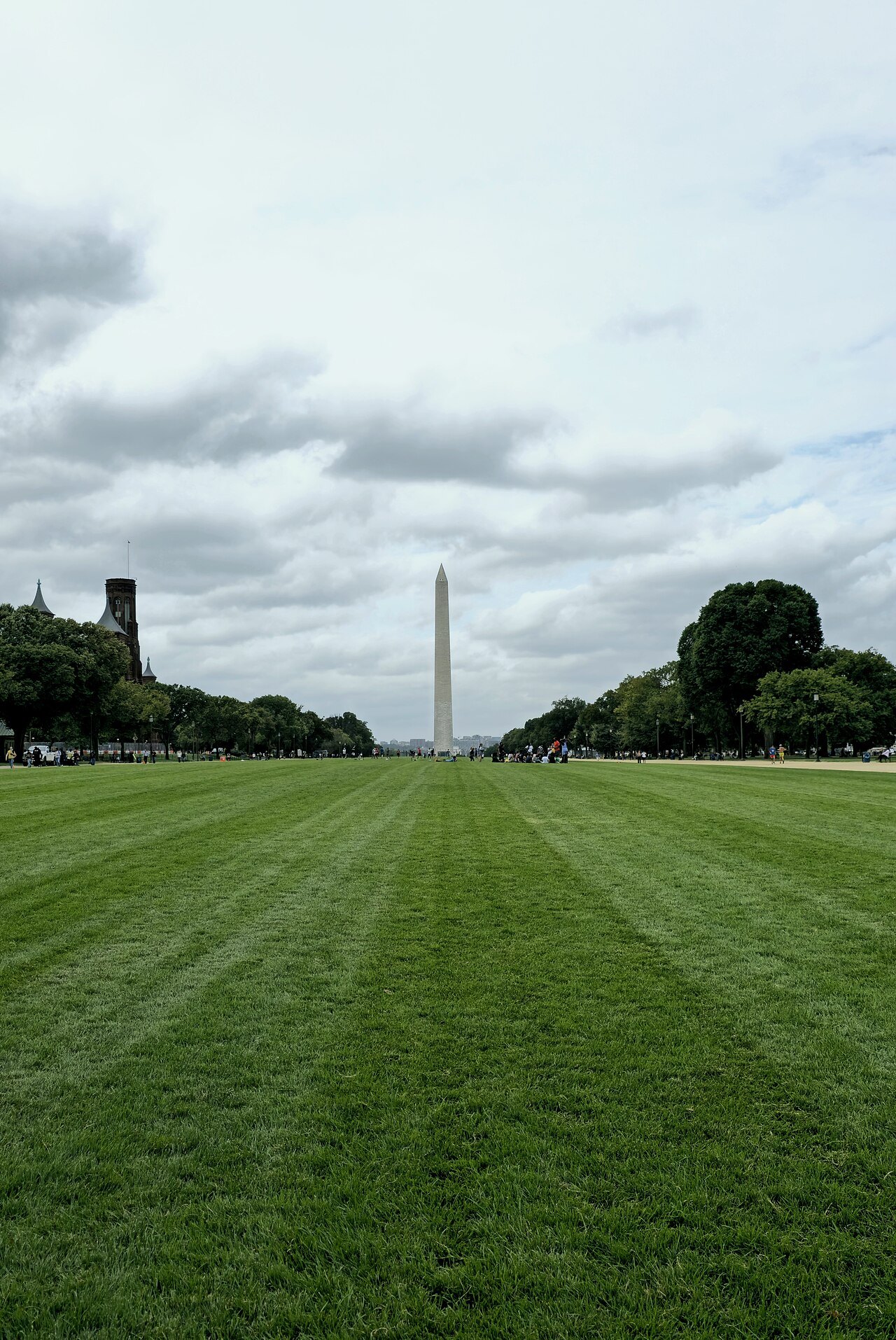
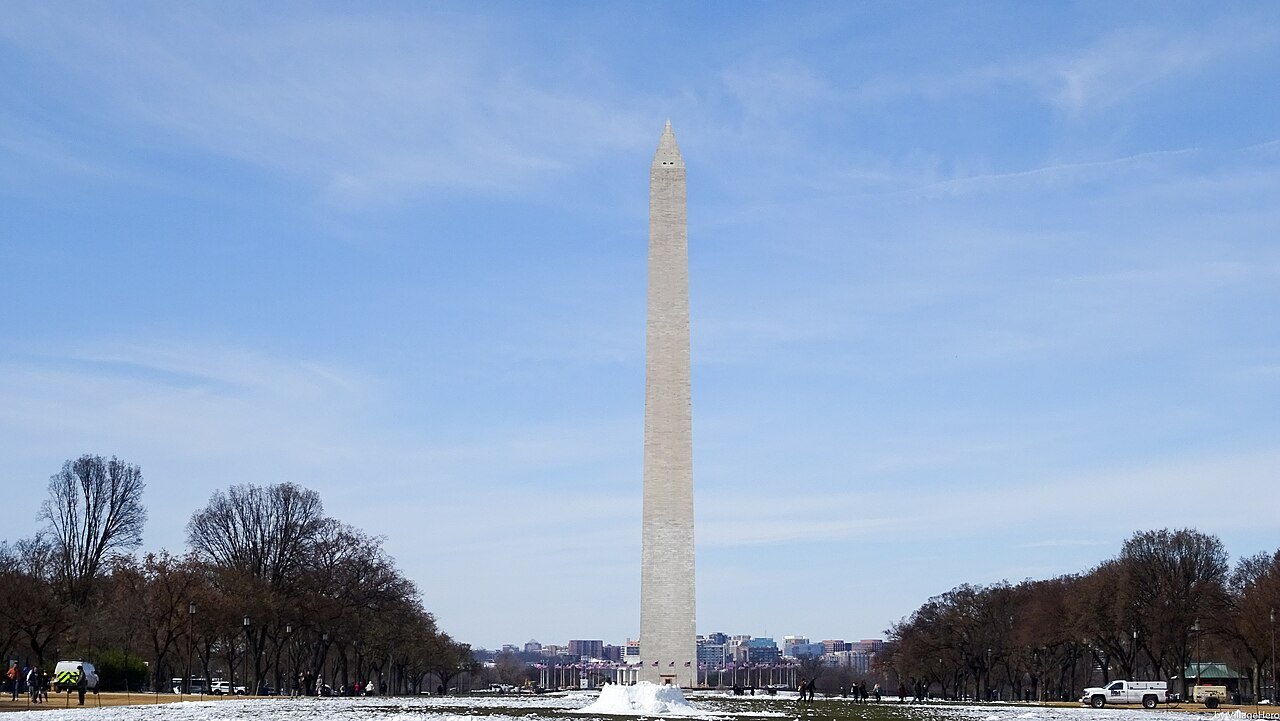
Look at the Washington Monument from anywhere on the Mall and you can see a change in color roughly a third of the way up the shaft: the lower part is a slightly different shade from the long upper section. The line is not a design feature. It marks the place where construction stopped in 1854, when the money ran out at a height of 152 feet, and where it resumed a quarter of a century later with marble from other quarries.
In all, the outer facing is made of three different kinds of white marble, laid in three phases, and the three shades can still be told apart. The monument is a record of its own troubled building, written in stone.
A private monument that ran out of money
The monument was begun not by the government but by a private body, the Washington National Monument Society, which raised money by public subscription. Robert Mills designed it, chosen in 1845, with an obelisk rising from a great colonnaded temple; in April 1848 the society, short of funds, decided to build the obelisk alone. The Freemasons laid the cornerstone on July 4, 1848 (see the Washington Monument).
The first phase was built of marble from quarries north of Baltimore, the stone known as Cockeysville marble, with much of the core of rough gneiss rubble held together by mortar. Work went on until 1854, when the donations ran out. In 1855 the nativist Know-Nothing party seized control of the society, and during its short tenure it added only two courses, about four feet, using masonry it found on the site that had already been rejected.
The stump
Then came the Civil War, and for more than twenty years the unfinished stump stood on the Mall, a broken-off column in the middle of the capital through the whole of the war. After the Know-Nothings surrendered the monument in 1858, argument continued about whether to finish Mills's design at all. Engineers studied the foundation several times to decide whether it could carry the full height, and the society finally agreed to drop the colonnade and give the obelisk the classical proportions of an Egyptian one.
Congress took over the project, and in 1879 construction resumed under Lieutenant Colonel Thomas Lincoln Casey of the Army Corps of Engineers. Before building higher, Casey strengthened the foundation so that it could carry a structure that would weigh more than forty thousand tons.
When building finally started again, the old top was the base of everything above it. The first stone was laid on the unfinished stump on August 7, 1880, in a small ceremony with President Rutherford B. Hayes, Casey and a few others present, and after that the shaft rose quickly. To keep the new weight within what the old base could bear, the walls above the stump were built thinner, and a large concrete slab was added under the old foundation to spread the load.
Three kinds of marble
When work resumed, the builders first laid about eight feet of white marble from Sheffield, Massachusetts, on top of the old Maryland stone. That was halted because of problems with quality, and the rest of the shaft, the final three hundred and ninety feet, was built of marble from the Beaver Dam quarry in Maryland, next to the quarry that had supplied the first phase. The stonework was completed in 1884, and a small aluminum pyramid was set at the apex.
So the monument has three bands of stone: the first-phase marble at the bottom, a thin band of Massachusetts marble, and the long upper section. Even marble from neighboring quarries, cut decades apart, weathers differently, and the lower section had also spent a quarter of a century standing exposed to heat, cold, damp and drought before anything was built above it.
Why the lower part looks different
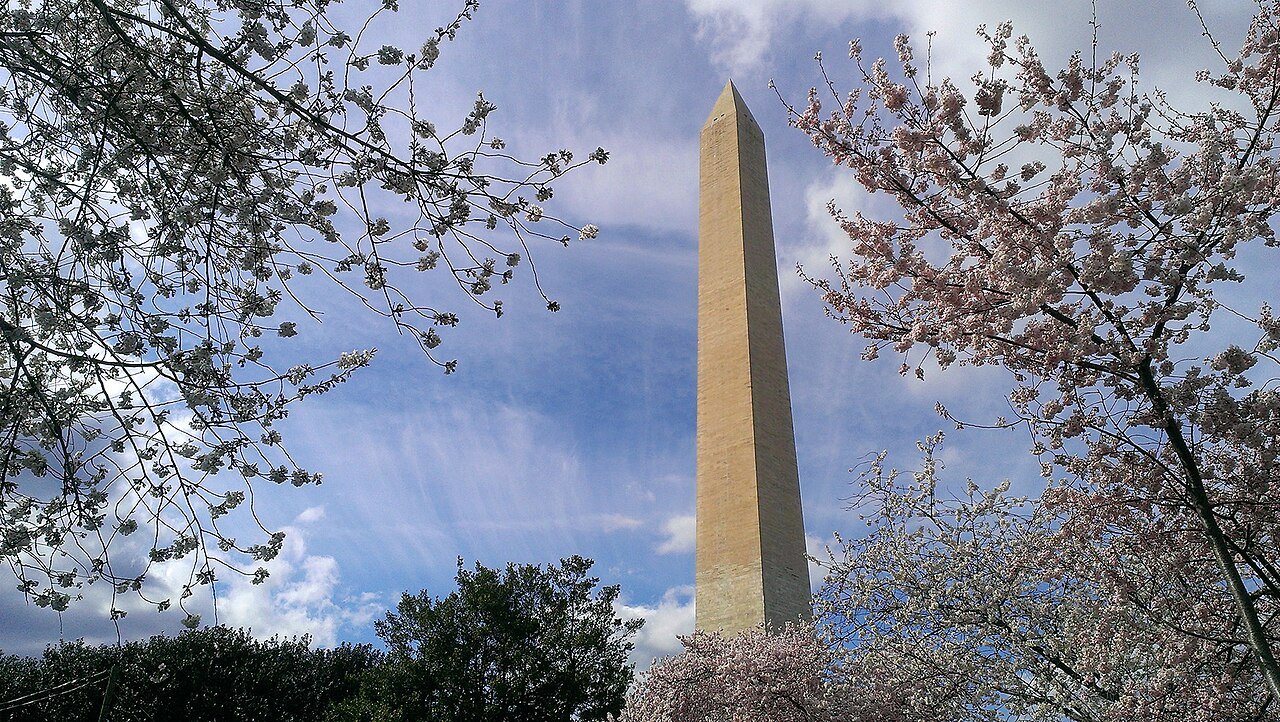
The weather did more than age the surface. The lower walls were built with the outer marble facing backed by rubble and cement, and over the years the filler between the outer and inner walls weathered. As the lower section went through cycles of cold and heat, damp and dryness, the material dissolved, worked its way through the cracks between the outer stones and solidified as it dripped down their faces.
The effect varies with the light. On a bright day, from the Mall, the change of tone is plain; in flat, grey weather, or at dusk when the monument is lit, it can almost disappear. It shows best from the side, looking along the shaft, and from a distance, such as from the steps of the Lincoln Memorial, the Tidal Basin or the west front of the Capitol.
Other traces of the building
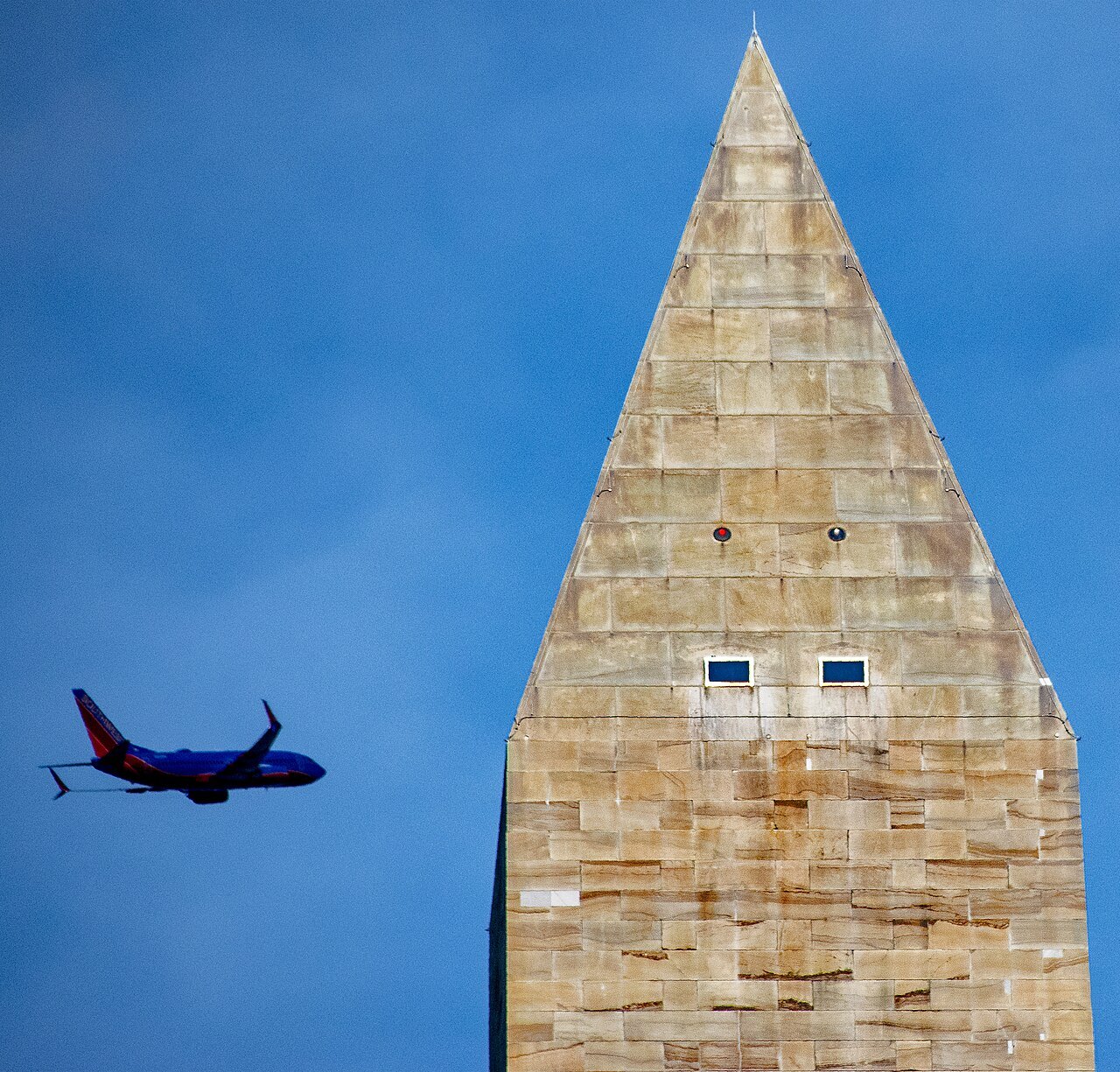
Inside, the story shows again. The interior walls are set with memorial stones given by states, cities, societies, countries and individuals, about 194 in all. When Casey resumed work he found 92 of them already set into the walls of the first phase, and he inserted most of the rest, stored on the site in the meantime, during the 1880s. One, given by Pope Pius IX, had been stolen and destroyed by Know-Nothings in 1854 and was replaced only in 1982.
The unbuilt temple left its mark too. Because Mills's colonnade was never built, Casey smoothed down the projecting doorway details designed to meet it, walled up the west entrance to form an alcove and reduced the height of the east entrance.
Seeing it
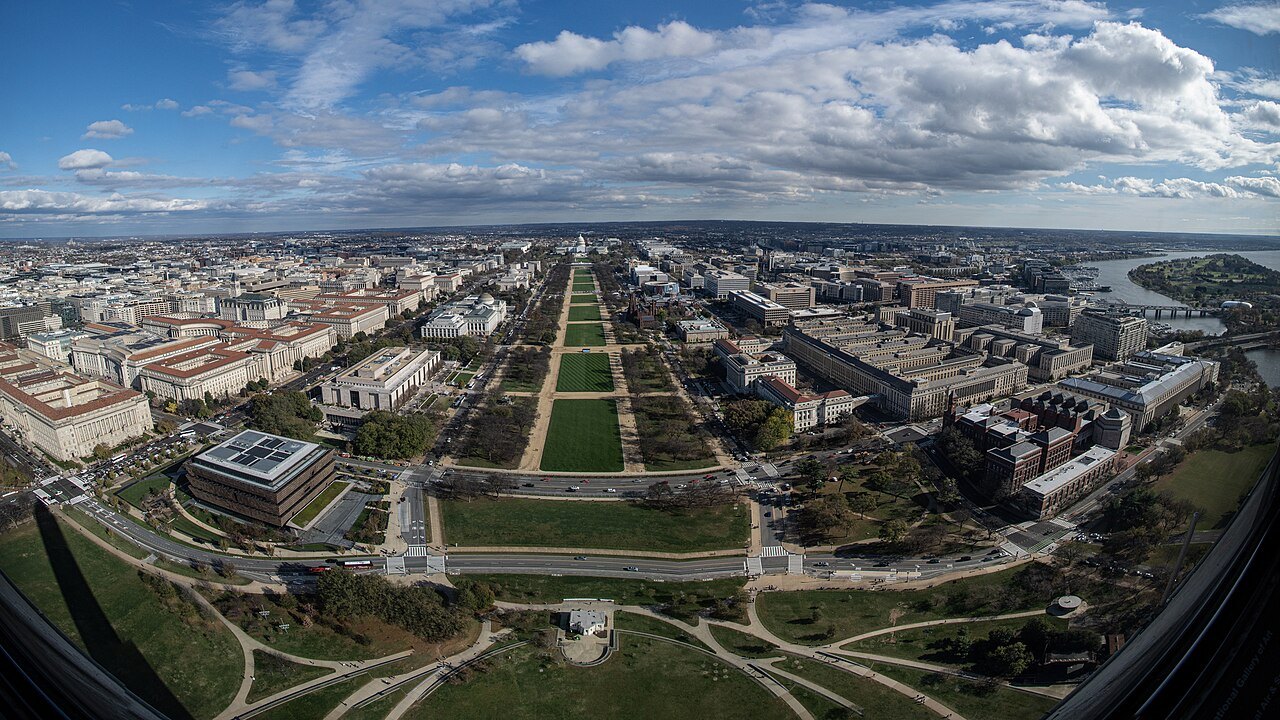
You can walk around the grounds and the base of the monument at any hour, and the color change is visible from all over the Mall. To go up inside, everyone aged two and older needs a timed ticket, reserved online with a small fee or picked up free on the day at the Washington Monument Lodge while they last (see booking ahead). From the observation level at the top, the line is out of sight below you, but the view down the Mall to the Capitol and the Lincoln Memorial is the plan of the city laid out at your feet.
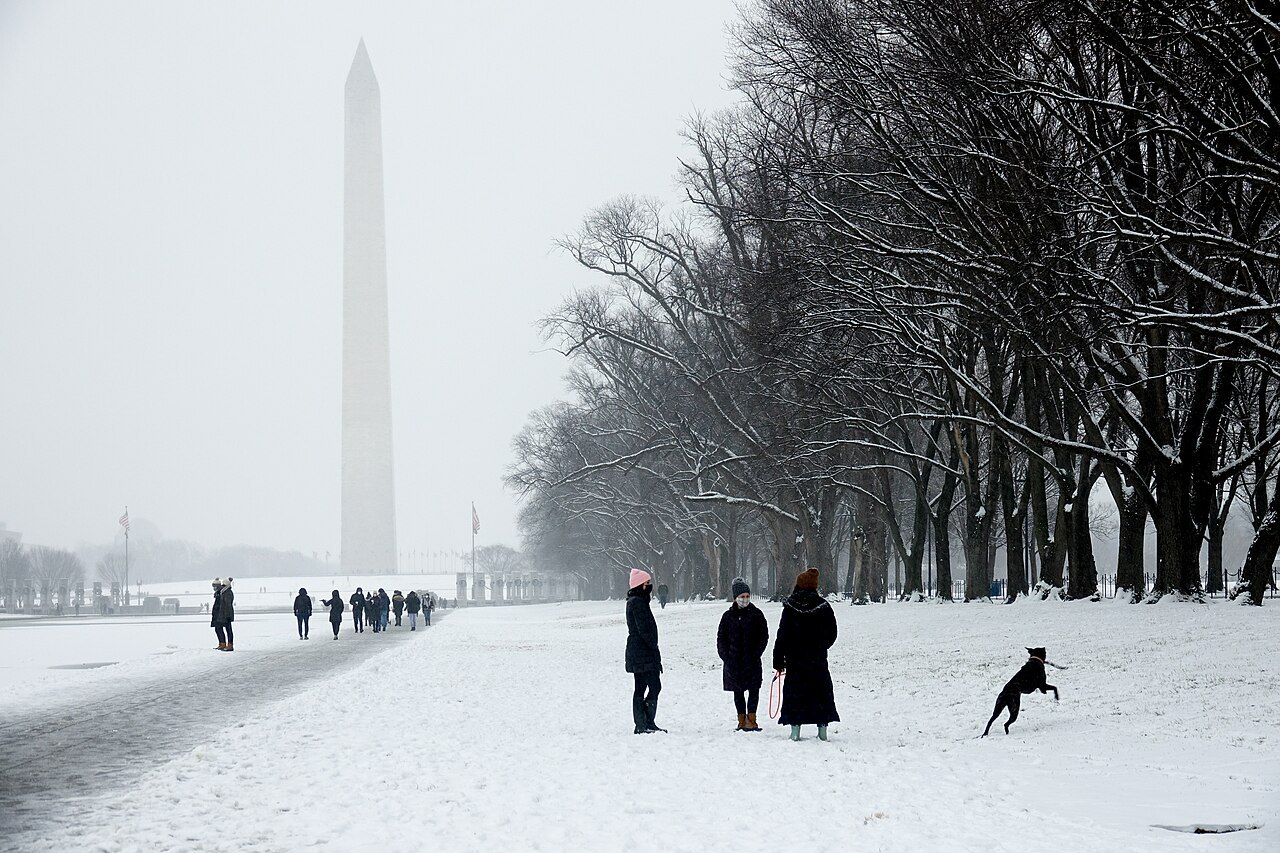
If the line is what you have come to see, pick a clear morning with the sun on the east face, or a late afternoon with it on the west, and stand far enough back to see the whole shaft at once. The grass by the Sylvan Theater, on the south side of the grounds, and the paths toward the World War II Memorial both give a clean, unobstructed look at it.
Read next03
More from the journal
- The National ArchivesWhy is the Declaration of Independence so faded?The Declaration in the National Archives Rotunda is barely legible, and the famous clear version is a copy made in 1823. How the signed parchment lost its ink, where it traveled, and how it is kept now.Read the piece →
- The Tidal Basin and the Jefferson MemorialWhen do the cherry blossoms peak in Washington?Peak bloom at the Tidal Basin usually falls between the last week of March and the first week of April, but it has come as early as mid-March and as late as mid-April. What peak bloom means, how the Park Service forecasts it, and how to plan a trip around a date nobody knows in advance.Read the piece →
- The White House and Lafayette SquareHow do you get a White House tour?Public tours of the White House are free, self-guided and arranged only through a member of Congress, up to six months ahead, with a background check for older visitors. How the request works, what you see, and what to do if you cannot get one.Read the piece →