
FINDING A NAME ON THE WALL01
How do you find a name on the Vietnam Veterans Memorial?
How the Vietnam Veterans Memorial orders its fifty-eight thousand names, and how to find one before you go.
The answer in full02
Read on
A Competition and a Design
The Vietnam Veterans Memorial began with a national design competition held in 1981, open to any American over the age of eighteen. One thousand four hundred twenty-one designs were submitted. The winner was Maya Lin, a young American architect, whose plan cut two walls of black granite into the ground in the shape of a V, each rising from nothing at the ends to just over ten feet where they meet.
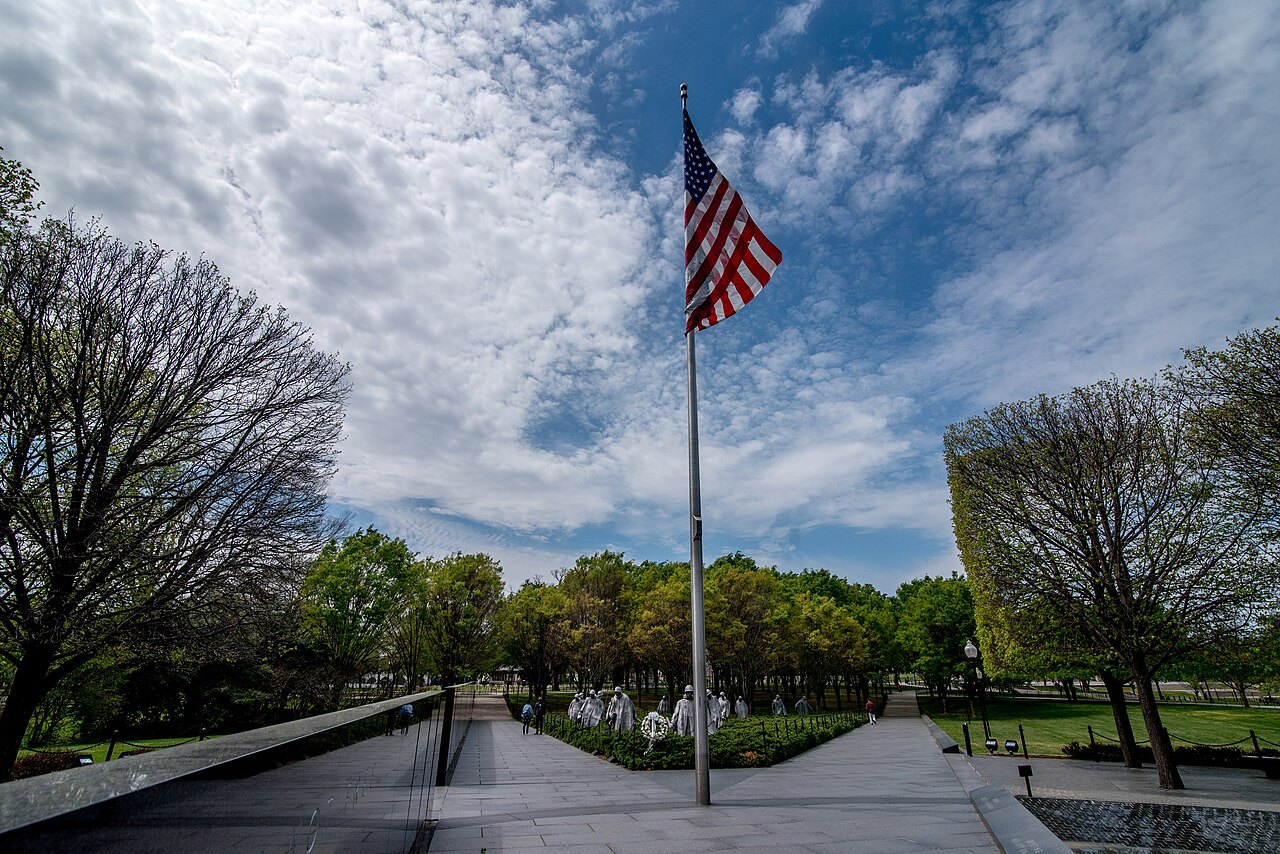
One wall points toward the Washington Monument and the other toward the Lincoln Memorial, so the Wall sits on the same sightline as the rest of the Mall's war memorials, in Constitution Gardens on the north side of the Reflecting Pool (see the Mall).
Each wall is two hundred forty-six feet nine inches long, built of polished panels that reflect the visitor and the sky as much as they carry names. There were fifty-seven thousand nine hundred thirty-nine names when the memorial was dedicated in 1982; by 2018 the count had grown to fifty-eight thousand three hundred twenty, as deaths and losses from the war continued to be confirmed.
The design was controversial when it was chosen, since it offered no figure and no inscription beyond the names themselves. Opponents wanted a traditional sculpture at the apex, so in 1984 Frederick Hart's bronze Three Servicemen was placed nearby, and the Vietnam Women's Memorial followed in 1993, both separate from Lin's walls rather than part of them.
How the Names Are Ordered
The names on the Wall are not alphabetical. They run in the order in which the men and women died or were reported missing, which means two people with the same surname may be on opposite ends of the memorial, while names close together often belong to the same unit, the same patrol, or the same day of fighting.

The sequence begins at the apex, where the two walls meet, with deaths from 1959, the early years of American involvement. It then runs outward along the east wall to its far end, breaks, and resumes at the far end of the west wall, working back toward the center and ending beside where it began.
This order makes the Wall a kind of chronicle of the war rather than a list of surnames, but it also means a visitor cannot simply walk along the panels looking for a name. Finding a particular one requires looking it up first, which is what the directories at each end of the memorial are for.
Using the Directories
At both ends of the Vietnam Veterans Memorial stand directories listing every name on the Wall together with its panel number and line. These are the starting point for anyone searching for a specific person, since they translate a name into a location: which of the numbered panels it sits on, and roughly how far down the panel.

The panels themselves are marked at their edges with numbers that run outward from the apex on each side, so a name's panel number also indicates roughly how close it is to the center, and therefore roughly when in the war the person died. Note the panel and line before approaching the Wall itself.
Visitors who are not sure how to read an entry, or who are searching for someone whose name may be recorded differently than expected, can ask staff of the National Park Service, who look after the memorial and can help confirm an entry in the directory.
Finding the Panel at the Wall
With a panel number and line from the directory, the search becomes a matter of walking the Wall itself. The granite panels are set in sequence along both the east and west walls, and small numbers at the base of each panel make it possible to count along until the right one is reached.
Because the walls rise from ground level to over ten feet at the center, panels near the apex carry their names well above eye level, while panels near the outer ends sit close to the ground. A line number from the directory indicates where on the panel, from top to bottom, a particular name falls.

The polished stone reflects both the sky and the people standing in front of it, which many visitors notice as soon as they find the name they came for. It is also why early morning or late in the day, when the light is low, is often when the inscriptions are easiest to read clearly.
What Visitors Leave
It has become customary for visitors to leave something at the base of the Wall beside a name: photographs, letters, medals, flags, and small personal objects. Several thousand items are left at the memorial every year, a practice that has continued since the Wall opened and was not part of its original design.
National Park Service staff collect these items regularly. Everything except perishable things such as fresh flowers is catalogued and kept in a museum store rather than discarded, preserving what visitors have chosen to leave as part of the memorial's own history.

The largest object ever left at the Wall was a sliding glass storm door fitted with a full-size replica of a prisoner's tiger cage, a reminder that what is left behind can be as personal, and as unexpected, as the names themselves.
Visiting the Rest of the Loop
The Vietnam Veterans Memorial is one stop on a loop that includes the other two war memorials of the Mall. All three are outdoors, free to visit, and need no ticket, so the order is a matter of convenience rather than rule.
A natural route runs from the National World War II Memorial at 17th Street along the north side of the Reflecting Pool to the Vietnam Wall, on to the Lincoln Memorial, and back along the south side past the Korean War Veterans Memorial. Allow at least an hour for the full loop, longer if searching for a specific name.
The World War II Memorial is best seen by day, when its fountain runs and sunlight catches the bronze reliefs along its approach, while the Korean War memorial's steel soldiers are most striking in low light, when their reflections merge with the mural wall beside them.

Before setting out, visitors planning a longer day on the Mall, including the Lincoln Memorial steps and the walk between sites, may want to check transit and timing details through getting around Washington, since the loop covers a considerable distance on foot.
Read next03
More from the journal
- The Washington MonumentWhy is the Washington Monument two colors?About a third of the way up, the Washington Monument changes shade. The line marks where building stopped in 1854 and started again in 1879, and the stone above it came from different quarries. How it happened and where to see it best.Read the piece →
- Getting AroundHow does the Washington Metro work for visitors?The Metro has six colored lines, 98 stations and fares that depend on distance and time of day, so you tap in and tap out. How to pay, find the right platform, change lines and reach the sights, the airports and Union Station.Read the piece →
- The White House and Lafayette SquareHow do you get a White House tour?Public tours of the White House are free, self-guided and arranged only through a member of Congress, up to six months ahead, with a background check for older visitors. How the request works, what you see, and what to do if you cannot get one.Read the piece →