A MUSEUM BUILT AS A CLIMB01
How is the National Museum of African American History and Culture arranged?
A floor-by-floor guide to the Smithsonian's newest museum, from the underground history galleries to the culture floors above.
The answer in full02
Read on
Why the Layout Tells a Story
The National Museum of African American History and Culture is built as a journey rather than a simple walk-through. Ten storeys rise and fall from its site at Constitution Avenue and 14th Street, five above ground and five below, and the architects arranged the galleries so that visitors move through history before they reach culture.
The lowest galleries hold the Middle Passage and the era of slavery, and the ceilings there are deliberately low and the rooms close, so the space presses in before the story widens into freedom and civil rights. Only after that long underground climb do the upper floors open into light, given over to music, art, and community life.
This arrangement is deliberate rather than incidental: the building argues with its shape as much as with its objects. A visitor who climbs straight to the top floors first sees a prop spaceship and a vintage Cadillac before reaching Emmett Till's casket, reversing the order the architects built the place to follow.
Below Ground: The History Galleries
The history galleries trace one continuous path, from the Middle Passage and slavery through emancipation, segregation, and the civil rights movement to the present day. Some of the largest objects could not wait for the building's completion: a segregated railroad passenger car and a guard tower from the Louisiana State Penitentiary were lowered into place by crane in 2013.
Among the objects on the route is a slave cabin, taken down board by board from Edisto Island in South Carolina and rebuilt inside the museum. Nearby are things that belonged to Harriet Tubman, including her hymnal and a shawl given to her by Queen Victoria, set against a drinking fountain once marked for Black use.
A biplane used in 1944 to train the Tuskegee Airmen hangs overhead along the route, and the hardest object to see is the glass-topped casket in which fourteen-year-old Emmett Till, murdered in Mississippi in 1955, was buried and shown to the world. Visitors routinely describe these underground floors as emotionally demanding.
Above Ground: Culture and Community
Above ground, the mood of the museum changes. The upper floors leave the chronological history behind and are organized instead around culture and community, covering music, visual art, sport, and everyday life. These galleries are higher and brighter than the rooms below, a contrast felt immediately after the climb through the history floors.
The music galleries hold the prop spaceship George Clinton used on stage with Parliament and Funkadelic, and Chuck Berry's cherry red Cadillac convertible. The art galleries include Allan Rohan Crite's Stations of the Cross of 1947 and David Driskell's Behold Thy Son of 1956, works set at a lighter register than the floors beneath them.
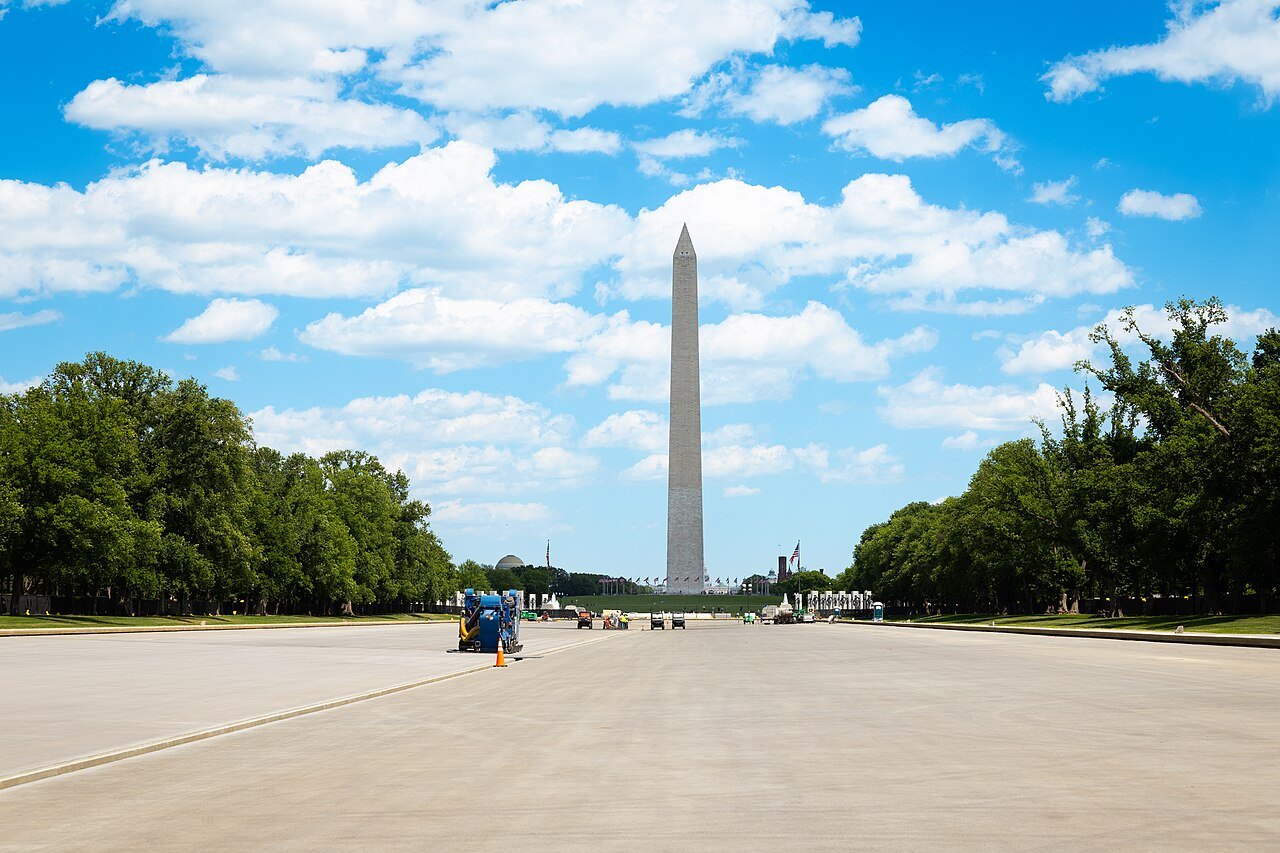
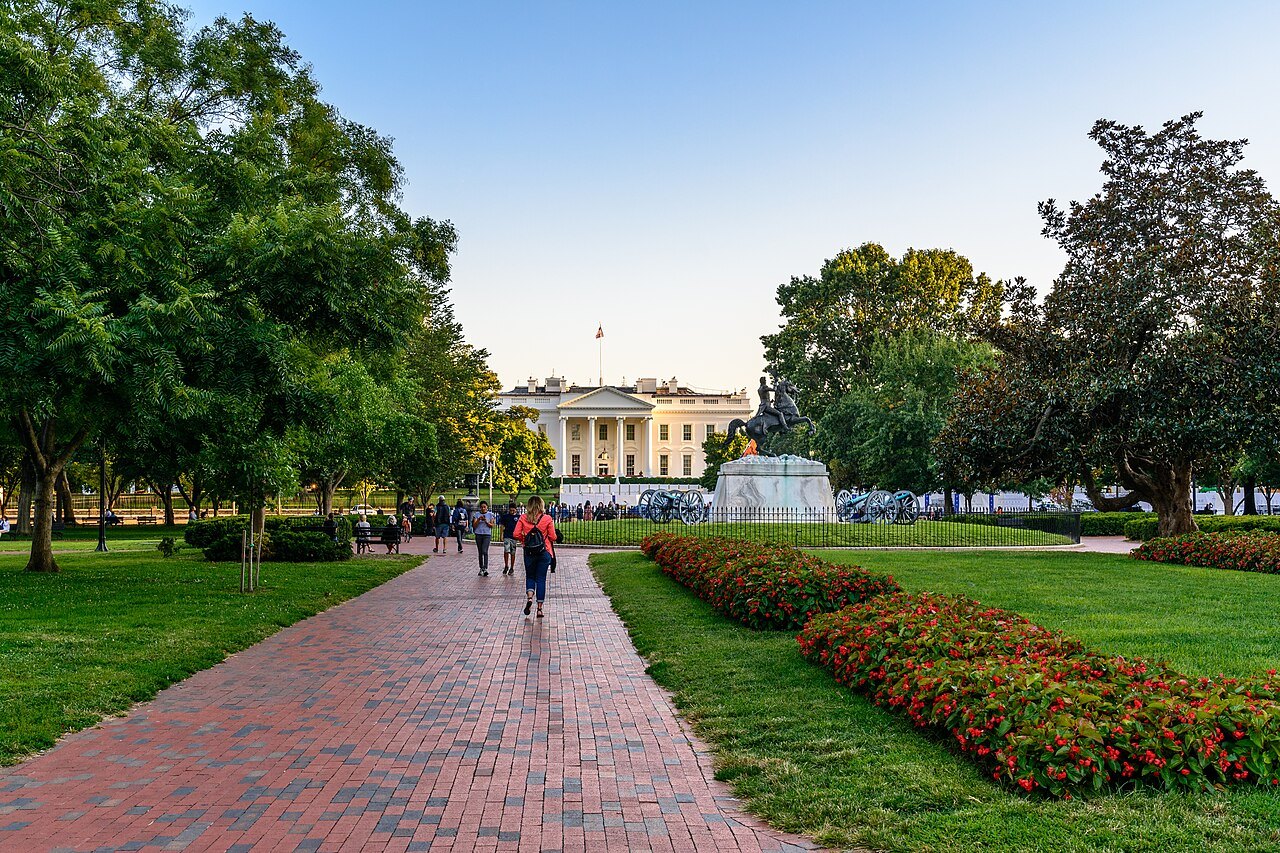
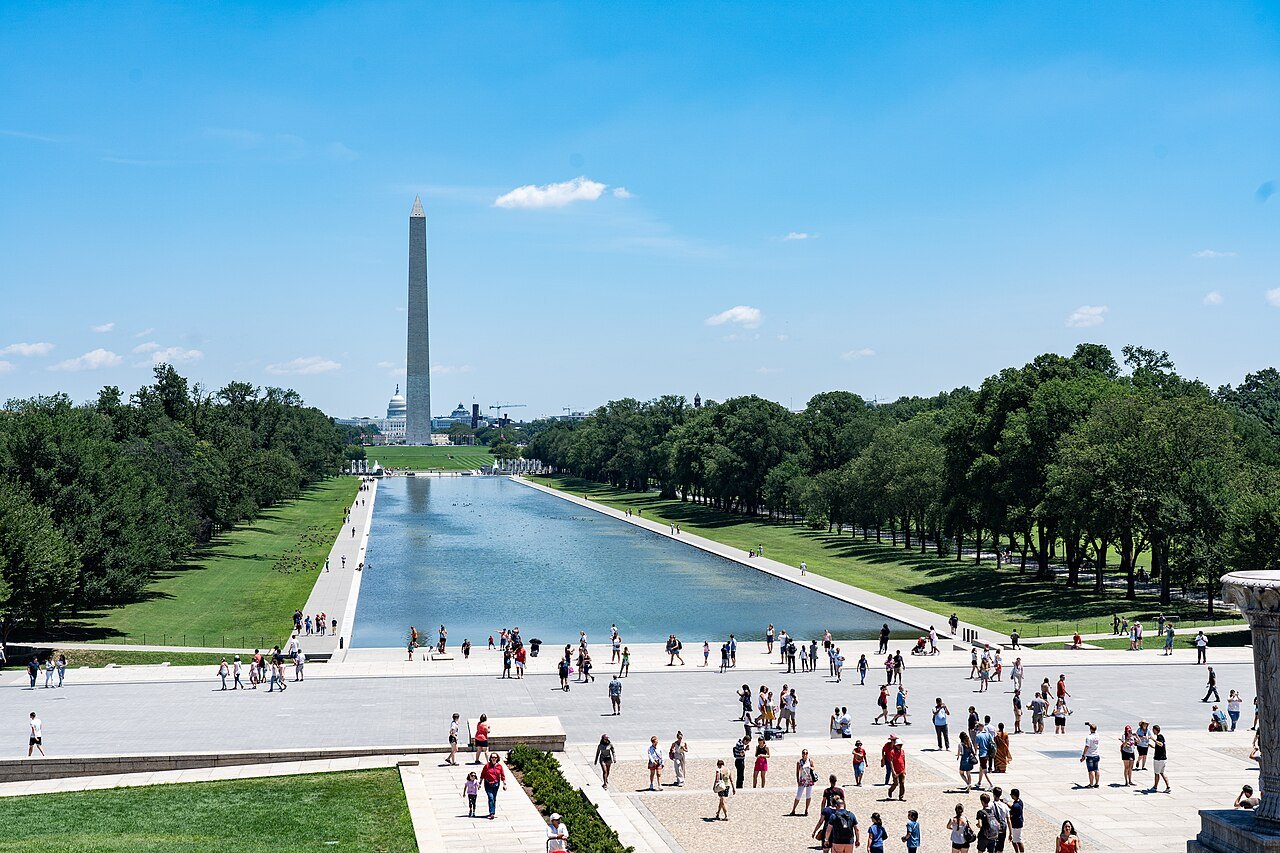
From the upper windows, the view opens onto the Washington Monument, which stands directly across 15th Street, a reminder of where the building sits on the Mall even as its subject reaches far beyond Washington. The National Museum of American History sits next door, making the upper floors a natural point to plan a next stop.
A Crown on the Mall
The site, chosen in 2006, sits at the corner of Constitution Avenue and 14th Street, just west of the National Museum of American History. Land had been set aside for a building here since both L'Enfant's plan of 1791 and the McMillan Plan of 1902.
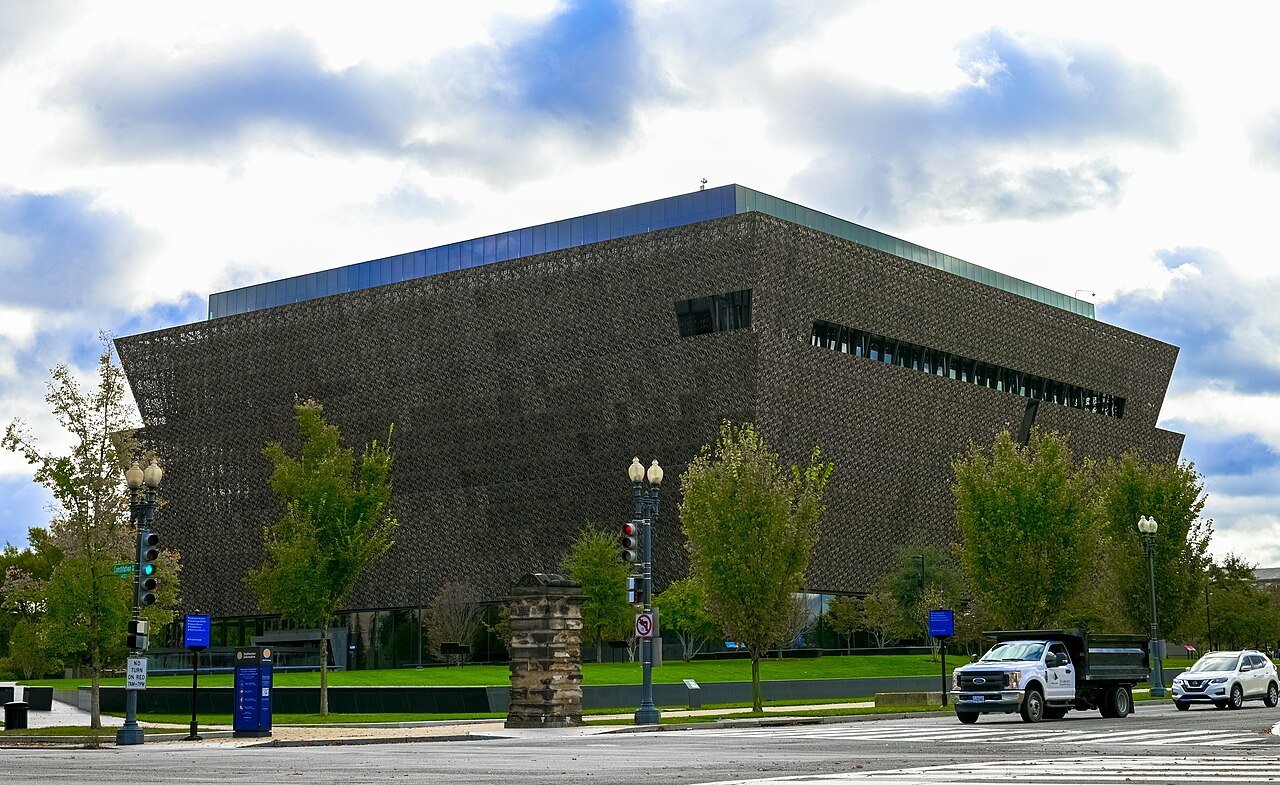
The design, by the Freelon Group, Adjaye Associates, and Davis Brody Bond, was chosen in 2009, and construction began with a groundbreaking in February 2012. On a Mall of white limestone and marble, the building stands apart: three stacked, inverted tiers, each wider than the one below, borrow their shape from an Oba's crown in Yoruba culture.
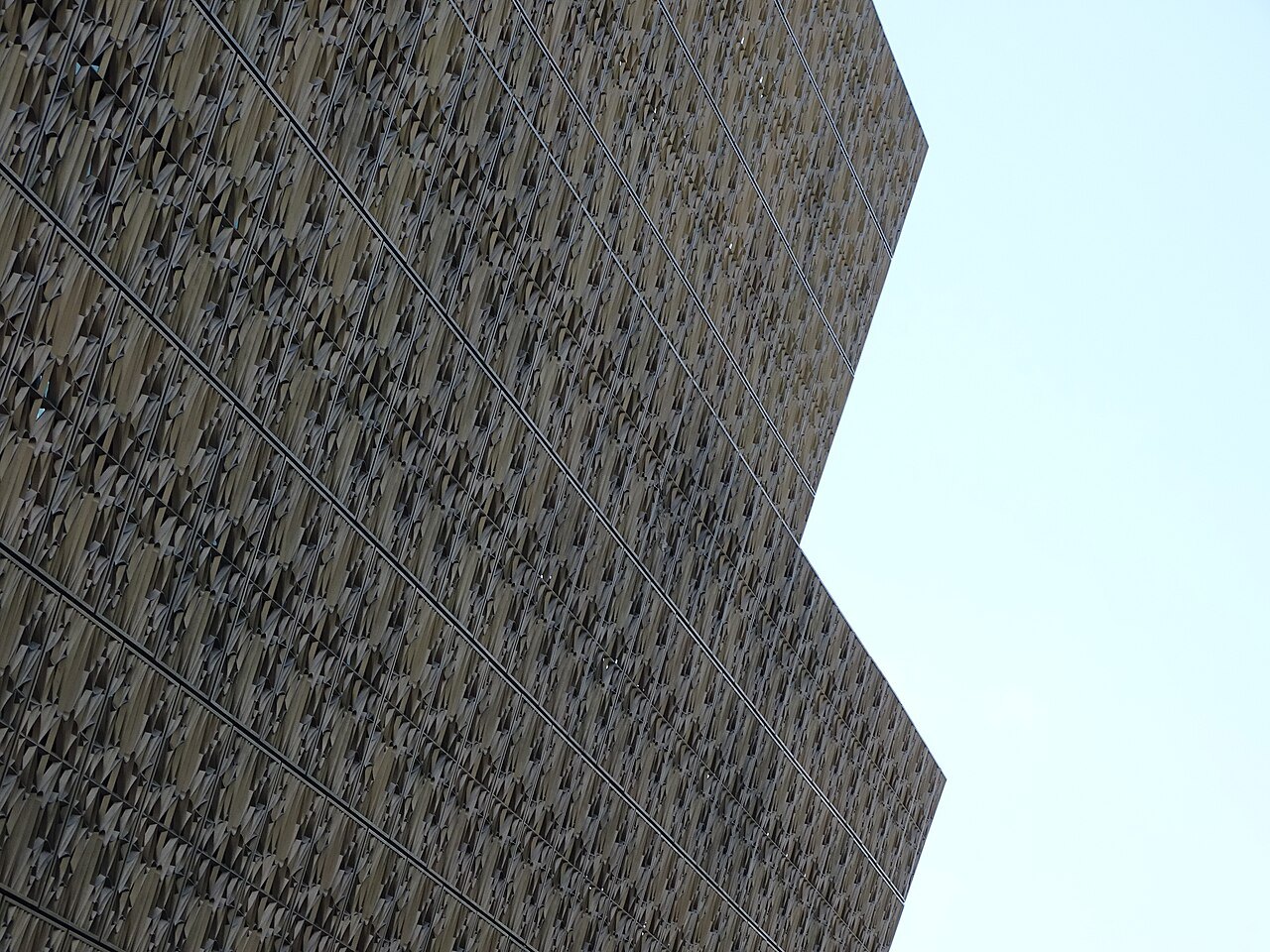
The specific model was the top of a sculpture by Olowe of Ise, one of the most important Yoruba artists of the twentieth century, now on display inside. The tiers are wrapped in a screen of three thousand six hundred bronze-colored panels, perforated with patterns drawn from the historic iron grilles made by Black craftsmen in Charleston and New Orleans.
The architects wanted the screen cast in real bronze, which would have made the building the only one on the Mall not faced in stone, but cost forced a change to bronze-painted aluminum in 2012; the Commission of Fine Arts approved the substitute while regretting the loss of bronze's warmth. A porch 200 feet long shelters the south entrance, reaching toward the Mall.
How the Museum Came to Be
The museum was established by Congress in 2003, after decades of advocacy, and opened its building on September 24, 2016, when President Barack Obama dedicated it together with four generations of one family, from ninety-nine-year-old Ruth Bonner to her great-granddaughter. More than six hundred thousand visitors came in its first three months, and more than a million within six.
The museum's path to completion took a century. The first proposal for a federal museum of African American history came in 1915; serious efforts resumed in the 1970s, and a legislative push beginning in 1988 finally led to its authorization by Congress. The building rose over four years, from groundbreaking to opening day, and people sometimes call it the Blacksonian.
Private gifts helped pay for the project, and the largest single gift came from Oprah Winfrey, for whom the Smithsonian named the museum's three-hundred-fifty-seat theater. The collection holds more than forty-five thousand objects, of which roughly three thousand five hundred are on display at any time, a scale that explains why even a long visit covers only part of the whole.
Planning Your Visit
Admission to the museum is free. Since opening, it has managed demand with timed-entry passes, and for a period also released a limited number of same-day passes, a release so heavily used it had to be scaled back. Check the museum's own pages, through the Smithsonian, for whether passes are needed on a chosen date; see booking ahead for how Smithsonian museums generally handle this.
Set aside more time than for most museums on the Mall. The history galleries alone take a long visit, and many visitors find them emotionally demanding, so it helps to plan a pause before moving on to the upper floors rather than trying to see everything in one continuous pass.
A workable plan is to go straight down to the history galleries first, while still fresh, letting the climb through slavery, segregation, and civil rights lead into the lighter culture and music floors above. The Washington Monument stands directly across 15th Street, and the National Museum of American History sits next door; see the Washington Monument and the Mall for what else is nearby.
Honest Notes
The building's bronze look is not bronze at all. Cost forced the architects to substitute bronze-painted aluminum for the real metal they wanted, and the Commission of Fine Arts approved the change while regretting that paint cannot match the warm sheen of cast bronze. Visitors who look closely at the panels are seeing a painted surface, not a cast one.
The museum does not display everything it owns. Of more than forty-five thousand objects in the collection, only about three thousand five hundred are on view at any one time, so a single visit, however long, shows a fraction of the whole. Which objects are on view can change between visits.
The building is larger than it looks from the Mall, because half of its ten storeys lie underground. That is why the history galleries feel like a descent at the start of a visit and only later become the climb toward daylight and the upper floors.
Read next03
More from the journal
- Getting AroundHow does the Washington Metro work for visitors?The Metro has six colored lines, 98 stations and fares that depend on distance and time of day, so you tap in and tap out. How to pay, find the right platform, change lines and reach the sights, the airports and Union Station.Read the piece →
- The Washington MonumentWhy is the Washington Monument two colors?About a third of the way up, the Washington Monument changes shade. The line marks where building stopped in 1854 and started again in 1879, and the stone above it came from different quarries. How it happened and where to see it best.Read the piece →
- The World War II, Korean War and Vietnam MemorialsHow do you find a name on the Vietnam Veterans Memorial?How the Vietnam Veterans Memorial orders its fifty-eight thousand names, and how to find one before you go.Read the piece →