FIFTY-SIX PILLARS, ONE MEMORIAL01
What do the pillars of the World War II Memorial stand for?
How the ring of fifty-six granite pillars at the World War II Memorial names every state, territory, and the Philippines of 1945.
The answer in full02
Read on
A veteran's question becomes a memorial
In 1987 Roger Durbin, a veteran of the war, asked his representative, Marcy Kaptur of Ohio, why no memorial yet marked his war on the Mall. She introduced a bill, and after four attempts in Congress, President Bill Clinton signed the World War II Memorial Act in 1993, setting a decade-long effort toward the memorial finally in motion.
Much of the money that followed came not from the federal government but from ordinary Americans across the country, who sent small donations by mail, and from veterans' groups that raised funds nationwide on the memorial's behalf. The design, by the Austrian-American architect Friedrich St. Florian, replaced the old Rainbow Pool that had stood at the east end of the Reflecting Pool.
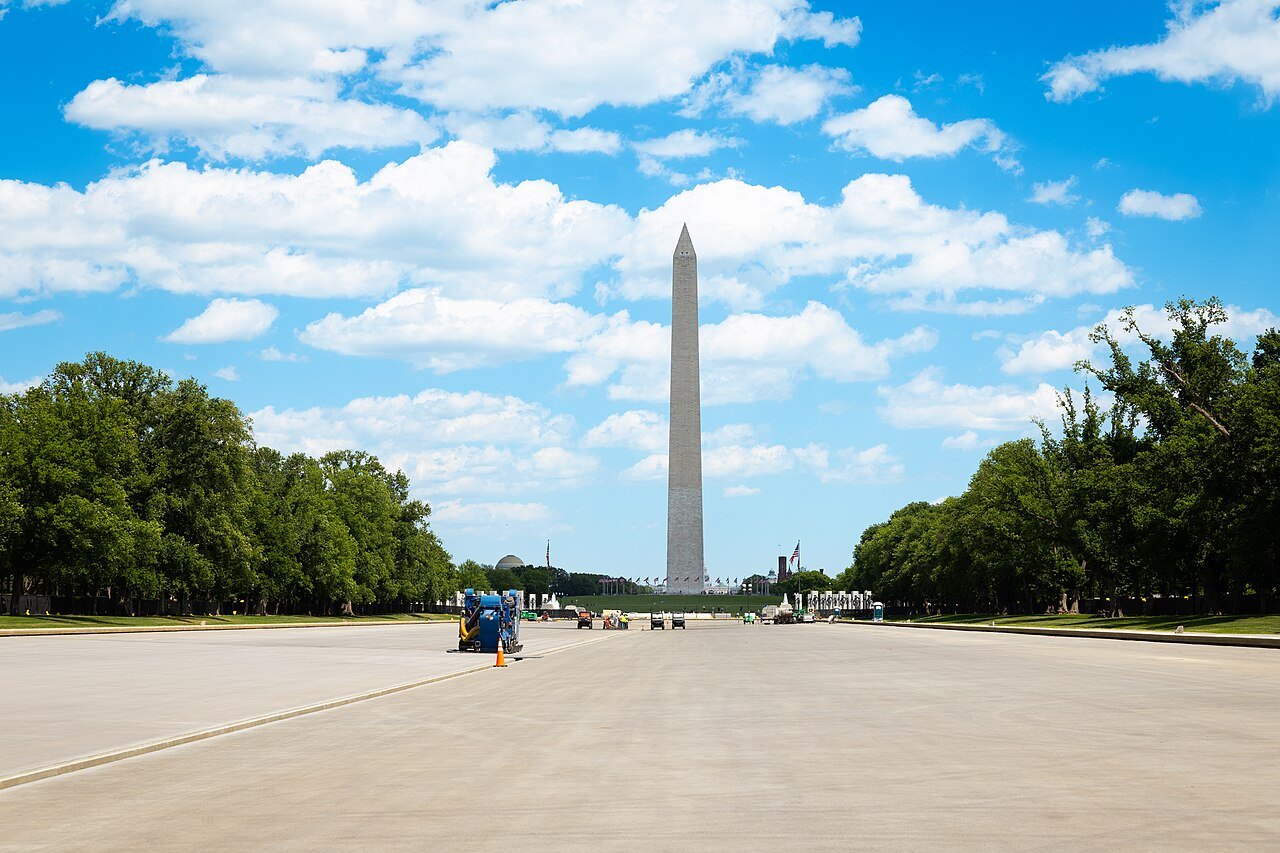
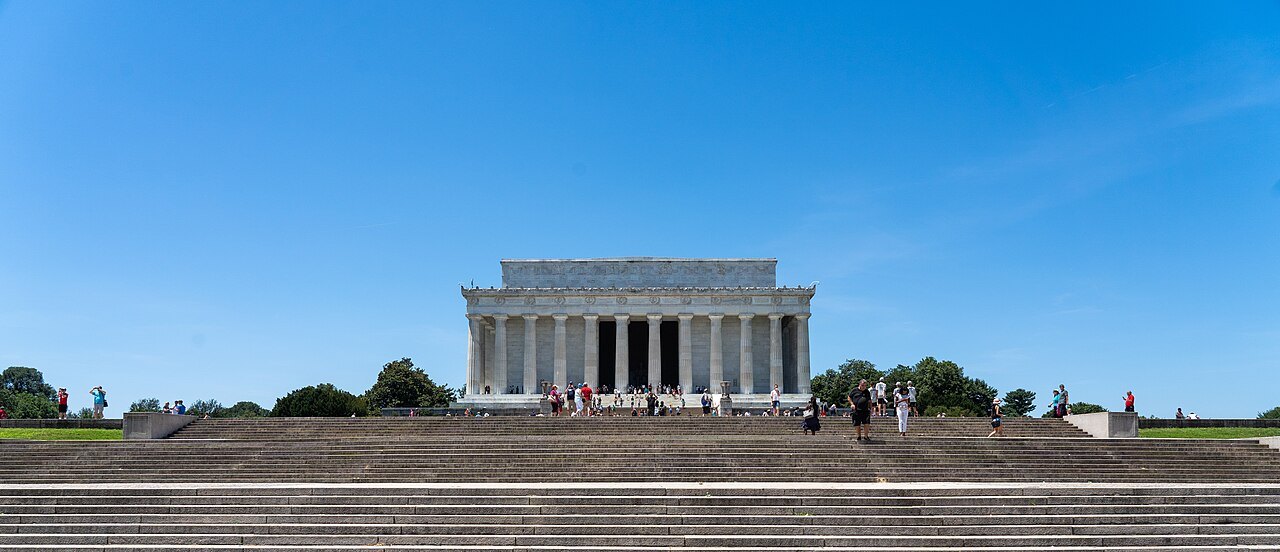
The memorial opened in April 2004 and was dedicated the following month, more than half a century after the war it marks had ended. It stands on the axis of Seventeenth Street, at the east end of the Reflecting Pool, between the Washington Monument and the Lincoln Memorial, the two monuments that already framed the Mall.
Fifty-six pillars for fifty-six places
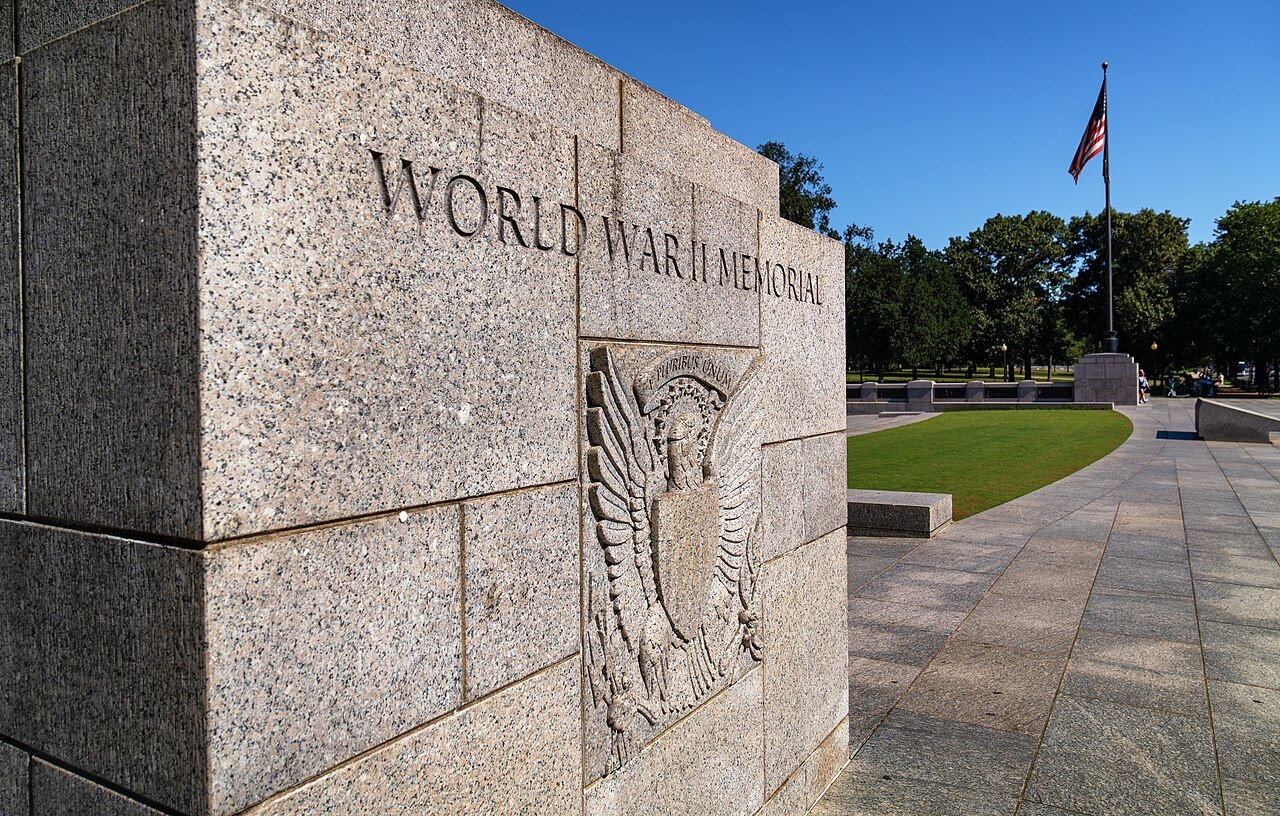
At the heart of the memorial is an oval plaza, sunk six feet below the surrounding ground, with a fountain playing in its pool. Around the plaza stand fifty-six granite pillars, each seventeen feet tall, hung with a bronze wreath and linked loosely by a bronze rope that runs from one pillar to the next, as if binding the states together.
Each pillar is inscribed with the name of one of the forty-eight states that made up the country in 1945, together with the District of Columbia, the territories of the time, and the Philippines, then under American administration. The number fifty-six stands for this full roll of places, not for the fifty states known today.
Walking the ring means passing the name of every state and territory that sent its people to the war, a way of answering the question the pillars pose simply by circling them: each stands for a single place, and together the fifty-six stand for the whole country that fought the war, coast to coast and overseas alike.
A visitor looking for a particular pillar needs no map: the inscriptions are cut plainly into the granite at eye height, and the ring is short enough to walk in a few minutes. Many visitors pause at the pillar for their own state, or for the territory an ancestor served from, before moving on to the arches and the wall beyond.
Two arches for two oceans
At the north and south ends of the plaza rise two arches, each forty-three feet high, one marking the Atlantic theater of the war and the other the Pacific. Together they frame the oval of pillars, setting the ring of states between the two fronts on which their soldiers served, an ocean apart from each other.
The approach from Seventeenth Street runs between low walls of bronze relief, following the war from the recruiting office to the homecoming. The Pacific campaign is shown on one side and the European campaign on the other, so a visitor walking in meets the whole arc of the war before reaching the pillars themselves.
Together the arches and the reliefs set the pillars in context. The ring of pillars stands for the home front, state by state and territory by territory; the arches and reliefs along the walk in stand for where that effort was spent, across two oceans and two very different wars within one war.
The Freedom Wall and a hidden joke
On the west side of the plaza, facing the Lincoln Memorial, stands the Freedom Wall, set with four thousand and forty-eight gold stars. Each star stands for a hundred Americans who died in the war, and an inscription below names them as the price of freedom, a reckoning kept separate from the ring of pillars that names the states instead.
Elsewhere in the memorial, easy to miss, are two small engravings of Kilroy was here, the doodle that American soldiers scrawled wherever they went during the war. Finding them is left to visitors; the memorial's keepers do not mark their location, and asking a park ranger on site is the surest way to be pointed toward them.
Between the pillars, the arches, the reliefs, and the Freedom Wall, the memorial answers the same question from several directions at once: by place of origin on the pillars, by theater of war on the arches, by campaign on the relief walls, and finally by the plain count of the dead on the Freedom Wall.
One of three memorials on the Mall
The World War II Memorial stands at the east end of the Reflecting Pool, between two other war memorials that answer the same question in very different ways. See the Mall for how all three sit together, on the stretch of ground between the Washington Monument and the Lincoln Memorial.
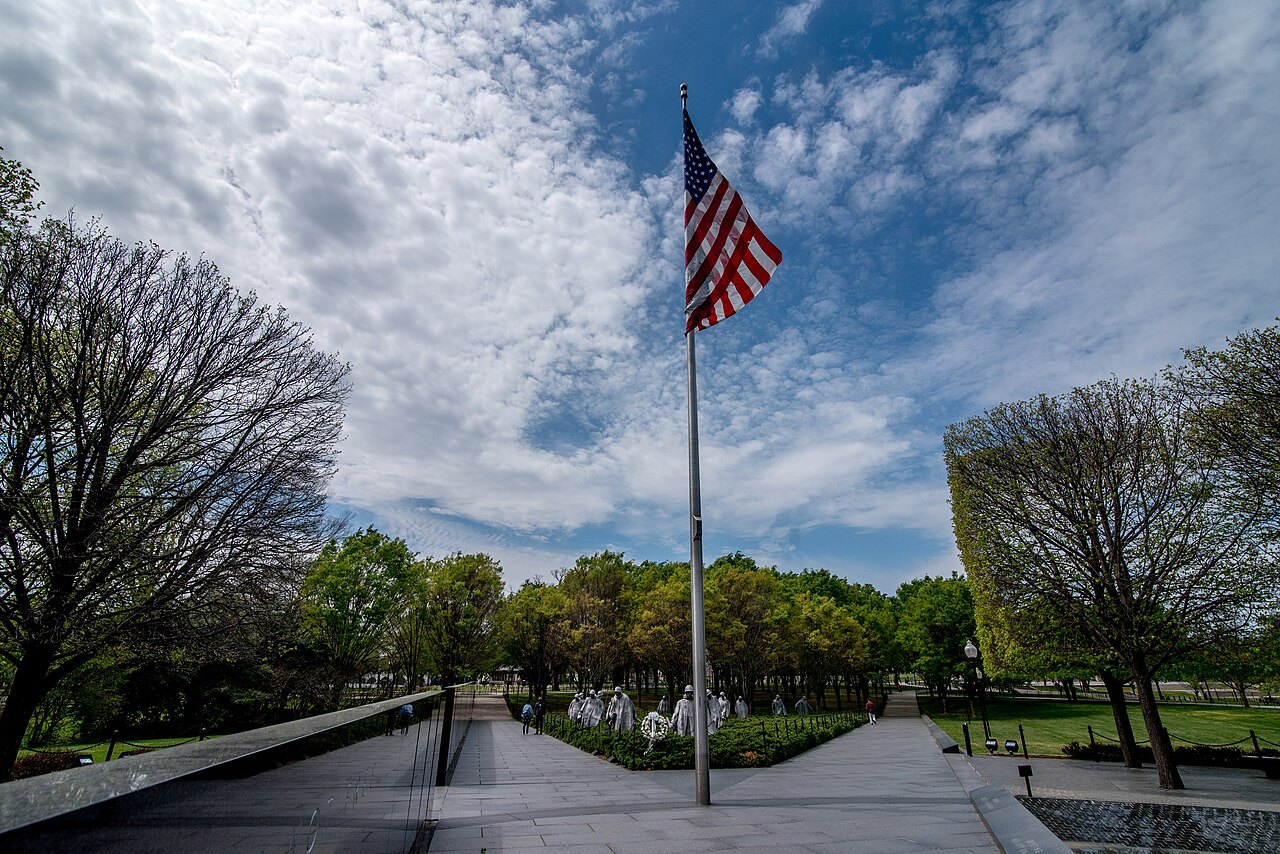
South of the pool, in West Potomac Park, is the Korean War Veterans Memorial, its steel soldiers on patrol among granite and juniper bushes that stand for the rugged terrain of Korea. North of the pool, in Constitution Gardens, the Vietnam Veterans Memorial lists its dead not alphabetically but in the order in which they fell.
All three are among the most visited places on the Mall: more than four and a half million people came to the World War II Memorial in a single recent year, and the Vietnam Wall draws many who come to find one name in particular. These are places of mourning as much as monuments, and visitors should move accordingly.
How to visit
The World War II Memorial is outdoors, free, and needs no ticket, and can be combined with the Korean War and Vietnam memorials in a single loop: north along the Reflecting Pool to the Wall, on to the Lincoln Memorial, and back past the Korean War memorial on the south side. Allow at least an hour for the full loop.
The pillars and reliefs are easiest to read by day, when the fountain runs and sunlight catches the bronze; the Korean War statues are most striking in low light, when the steel figures merge with their reflections in the granite mural beside them, so an early or late visit shows a different memorial than a midday one.
To find a particular name on the Vietnam Wall, the directories at each end give its panel and line, and the National Park Service, which maintains all three memorials, can answer further questions on site, from the condition of a panel to where a ranger can be found nearby at the memorial.
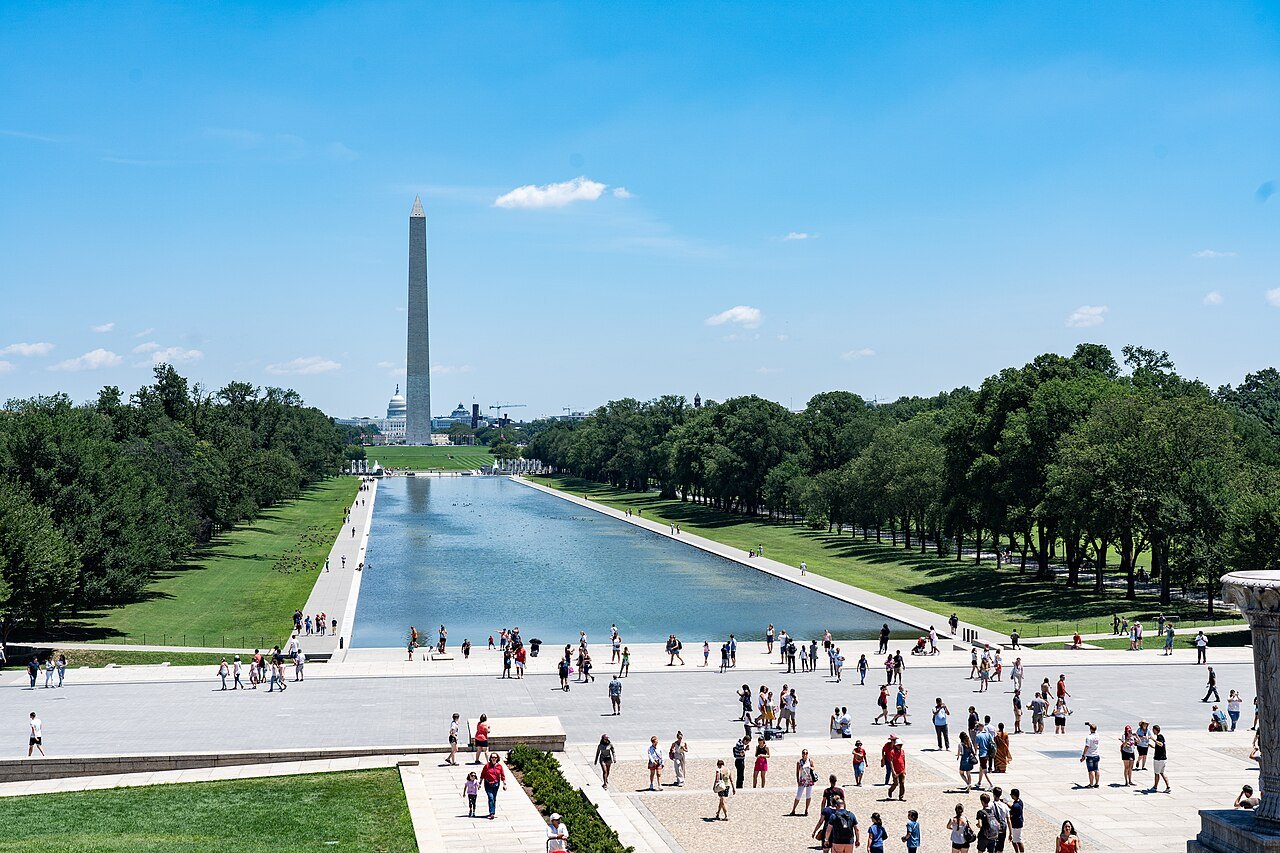
Because the three memorials line the Mall between two of the city's most recognizable monuments, a visit to the World War II Memorial pairs naturally with a longer walk that takes in the Lincoln Memorial and the war memorials beyond it. See war memorials for a fuller account of the Korean War and Vietnam Veterans Memorials that complete the loop.
Read next03
More from the journal
- The World War II, Korean War and Vietnam MemorialsHow do you find a name on the Vietnam Veterans Memorial?How the Vietnam Veterans Memorial orders its fifty-eight thousand names, and how to find one before you go.Read the piece →
- Getting AroundHow does the Washington Metro work for visitors?The Metro has six colored lines, 98 stations and fares that depend on distance and time of day, so you tap in and tap out. How to pay, find the right platform, change lines and reach the sights, the airports and Union Station.Read the piece →
- The White House and Lafayette SquareHow do you get a White House tour?Public tours of the White House are free, self-guided and arranged only through a member of Congress, up to six months ahead, with a background check for older visitors. How the request works, what you see, and what to do if you cannot get one.Read the piece →