INSIDE THE DOME01
What is inside the Capitol Rotunda, and who painted its dome?
A guide to what fills the Capitol Rotunda, who painted its dome, and how to see both on a free tour.
The answer in full02
Read on
The room under the dome
The Rotunda sits at the center of the Capitol, directly beneath the dome, and every guided tour of the historic building passes through it. It is ninety-six feet across and rises one hundred eighty feet to the canopy overhead, a space built where the Senate's north wing and the House's south wing meet, on either side of this single round room.
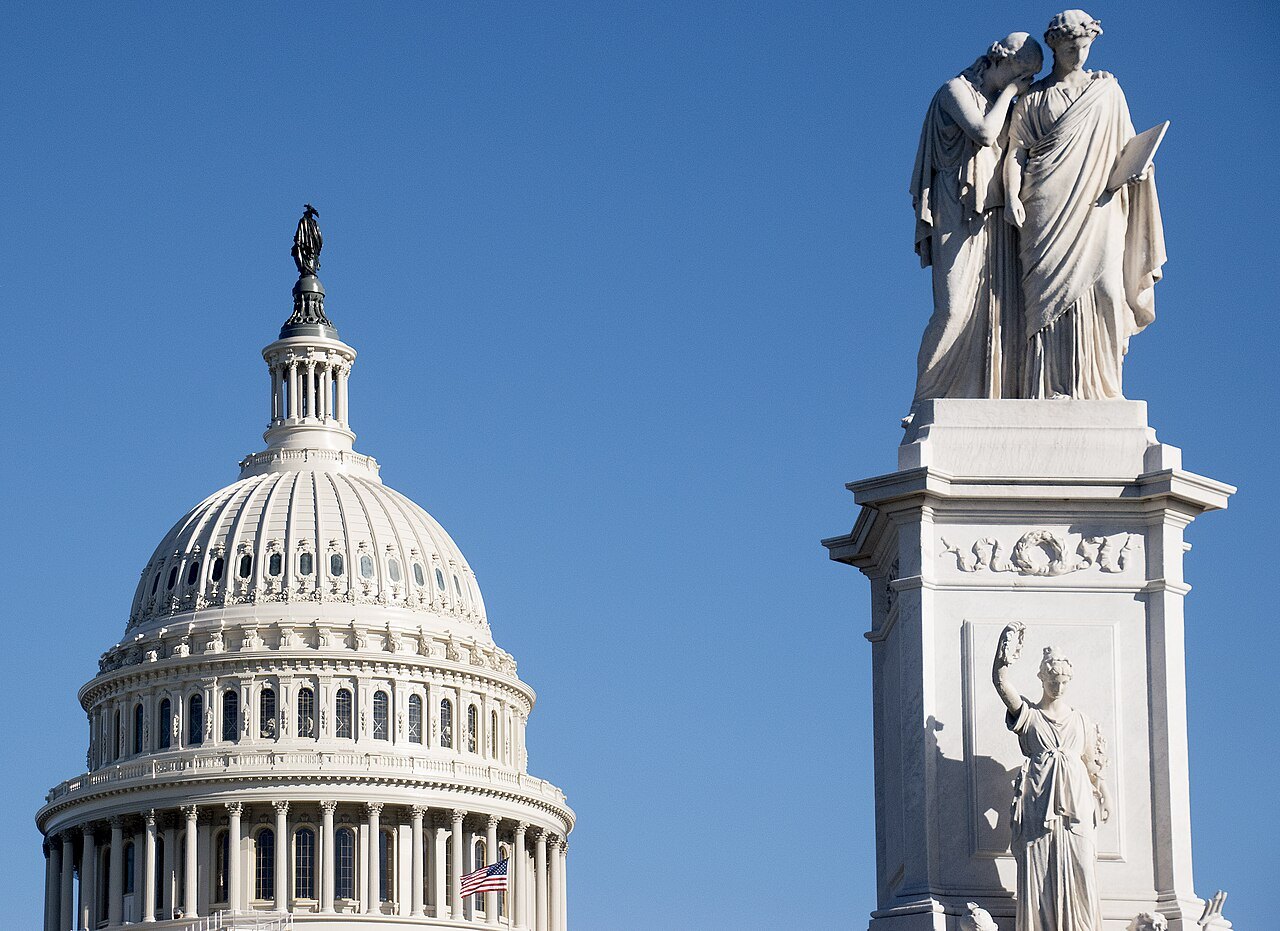
Outside, on top of the dome, stands Thomas Crawford's bronze Statue of Freedom, set in place in 1863 while the Civil War was still being fought. The plaster model used to cast it now stands in Emancipation Hall, part of the underground Capitol Visitor Center where every visit to the Capitol begins.
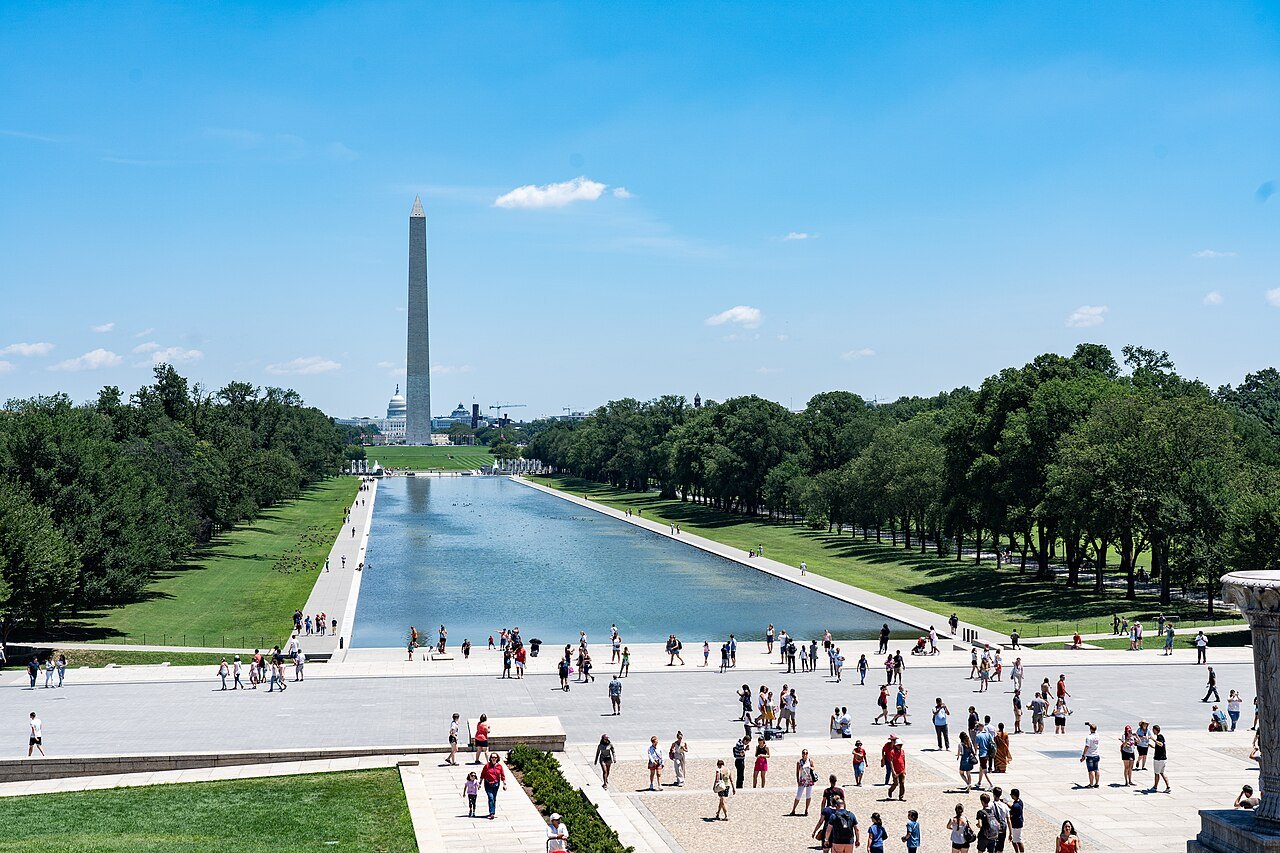
From the Capitol's own terraces, the dome is the fixed point at the eastern end of the whole axis of the Mall, with the view running west past the Washington Monument to the Lincoln Memorial. The hill was chosen for exactly this effect: Pierre Charles L'Enfant picked the rise, once called Jenkins Hill, in his 1791 plan, and called it a pedestal awaiting a monument.
The dome overhead
The dome did not come first. In 1792 Thomas Jefferson proposed a competition for the Capitol, and a late entry by William Thornton, a physician and amateur architect, won George Washington's praise for its grandeur and simplicity. Washington laid the cornerstone on September 18, 1793, and the central sections were ready for Congress to meet there by November 17, 1800.
Benjamin Latrobe rebuilt the interiors of the two wings, and after British forces burned the Capitol in 1814, it was restored within five years. Charles Bulfinch then finished the center with a low dome of timber and copper, but by 1855 it was too small for a growing Capitol, and Thomas U. Walter was asked to design its replacement.
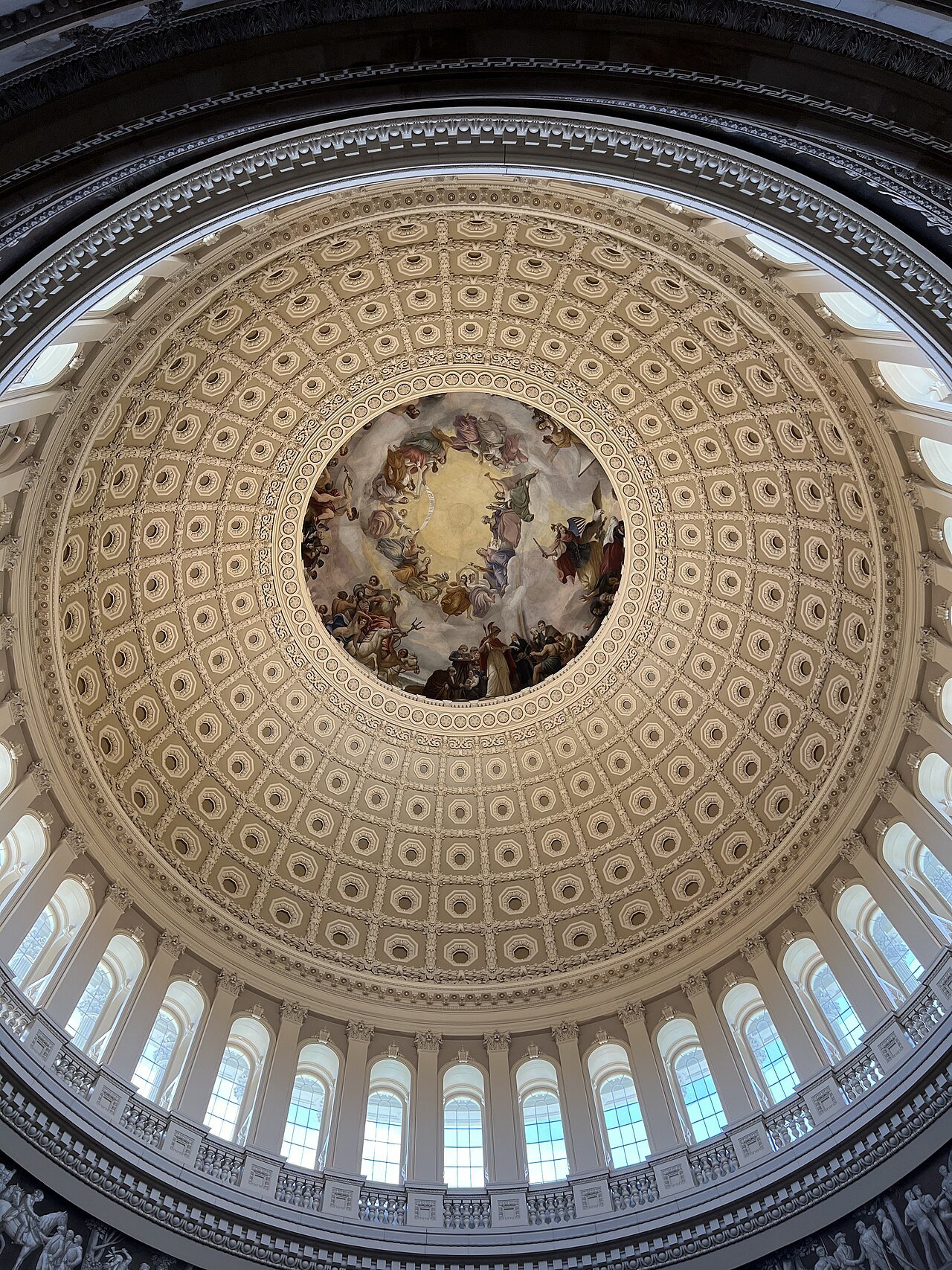
Walter's dome, the one standing today, is cast iron, three times the height of Bulfinch's and about one hundred feet across, set on the existing masonry piers. Like the dome of Les Invalides in Paris, which Walter had studied, it is built in two shells: an inner dome with an oculus, and above it the taller outer shell visible from the Mall.
Looking up through the oculus, visitors see The Apotheosis of Washington, the fresco Constantino Brumidi painted on a shell suspended beneath the outer dome, more than four thousand six hundred square feet in size, completed as work on the dome itself wound down around 1866, and still the single image most associated with the building.
Below the Rotunda: the Crypt
A room of heavy columns sits directly beneath the Rotunda, built in the Capitol's early years to hold George Washington's tomb. His will asked that he be buried at his own home instead, so the Crypt never held his body; it now holds exhibits on the building's history.
Set into the floor is a compass star, the point from which the city's four quadrants, Northwest, Northeast, Southeast and Southwest, are measured; every street address in this guide carries one of those quadrants for that reason. Read more on how that system works in the plan of the city.
Nearby stands Gutzon Borglum's marble head of Abraham Lincoln, carved in 1908 from a block of marble weighing six tons. It is a quieter stop than the Rotunda above it, set among the Crypt's heavy columns, and tours generally pause there only briefly on the way through to Statuary Hall.
The paintings on the walls
Around the walls of the Rotunda hang eight large paintings, easy to overlook while photographing the dome but worth a slower look on the way through. Four are scenes from the Revolution painted by John Trumbull, commissioned by Congress in 1817, among the building's first major works of art.
The eight paintings ring the room at eye level, well below the frieze and far below Brumidi's fresco overhead, so a turn on the floor takes in work from different decades of the Capitol's history side by side. A guide usually points out only a handful of the eight on a timed tour.
Because the tour route through the building can change, which paintings are visible from the floor, and in what order, can vary slightly from one visit to the next. Visitors curious about a particular scene are free to ask the guide walking the group through the Rotunda, who can usually point it out directly.
National Statuary Hall and the chambers above
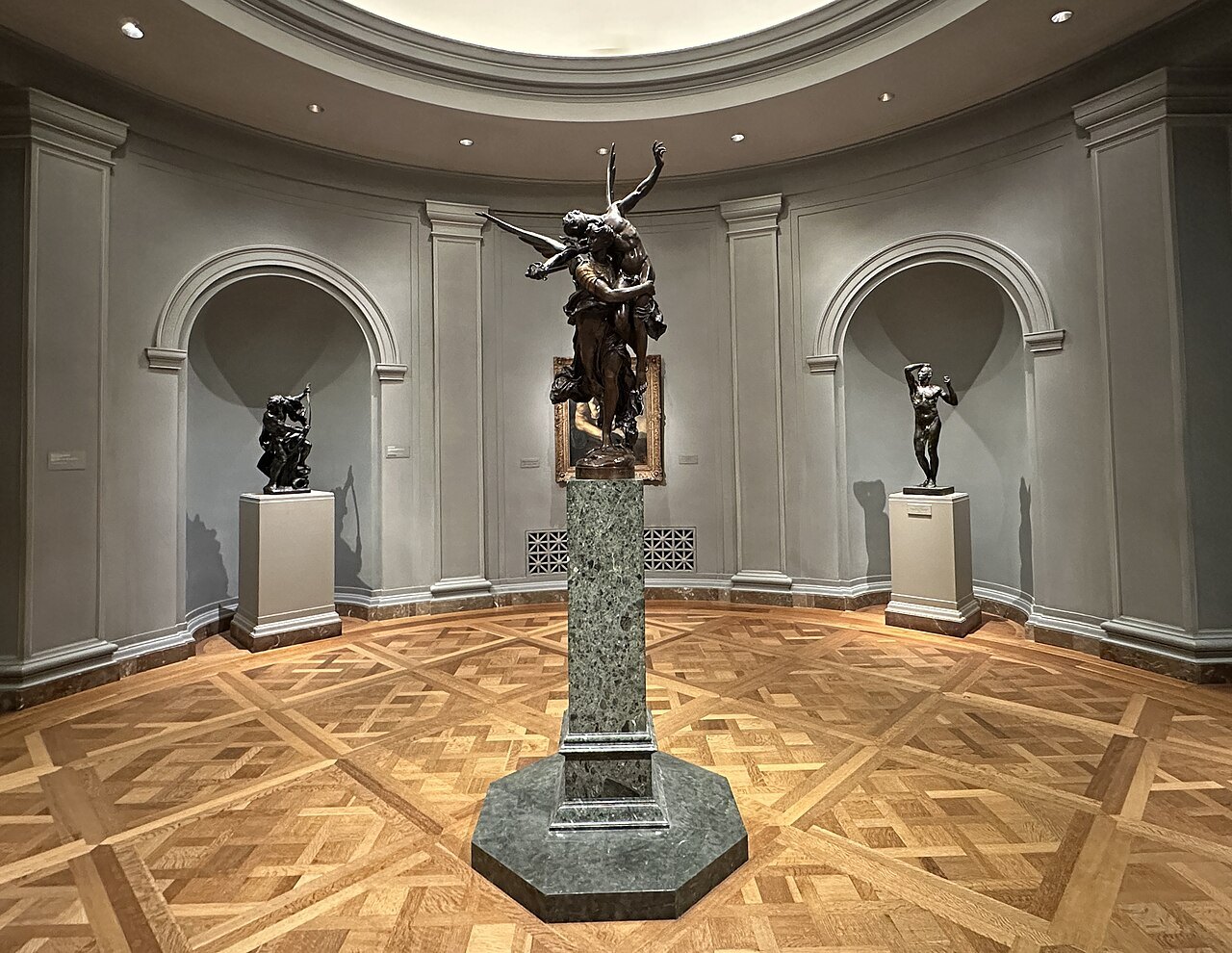
South of the Rotunda is National Statuary Hall, a semicircular room where the House of Representatives met for nearly fifty years, from 1807 to 1857, before Congress outgrew it. After some years of disuse, the room was given over to statues of prominent Americans in 1864, and it still serves that purpose.
The working Senate and House chambers sit above the route any Rotunda tour follows, and are not part of it; they can be seen only from the public galleries. Access is arranged separately, typically through a member of Congress's office, so a visitor who wants to watch a session should check that route well ahead.
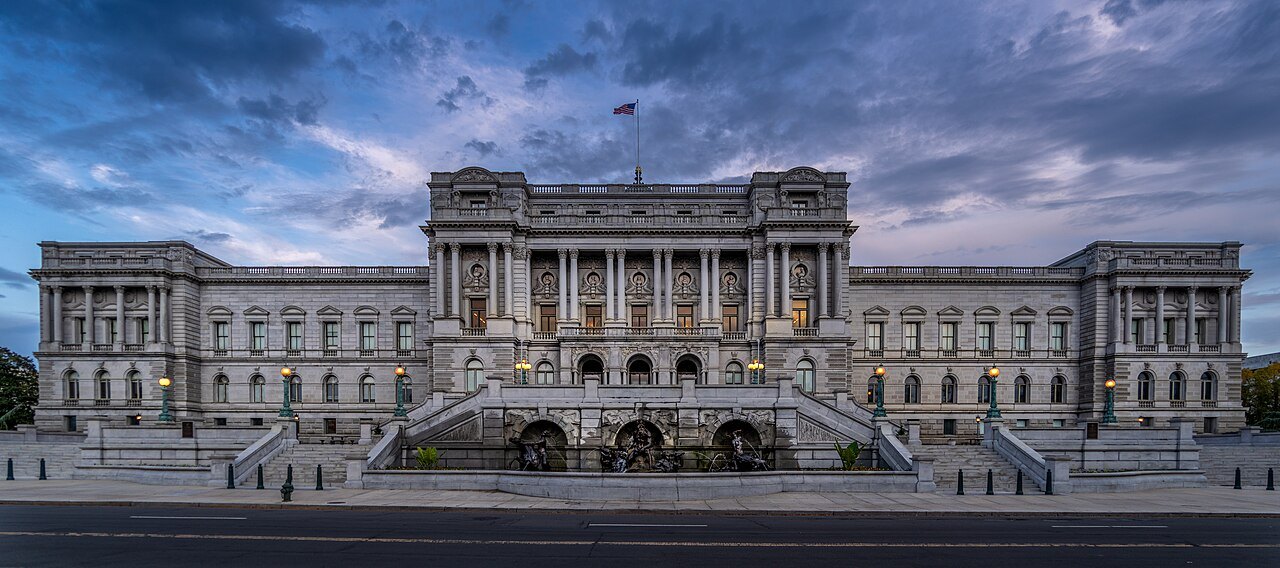
Statuary Hall and the chambers above it both date from the building's long growth. The extensions of the 1850s, designed by Thomas U. Walter, more than doubled the Capitol's length and added the present House and Senate wings, facing the Library of Congress and the Supreme Court across First Street.
How to visit
Every visit begins underground, at the Capitol Visitor Center on the east side of the building. The historic rooms, including the Crypt, the Rotunda and National Statuary Hall, can be seen only on a guided tour, and the exact route can change from day to day, depending on how the building is being used.
The Capitol's own visitor site recommends booking a reservation ahead of time, and says that visitors who arrive without one are placed on the next tour with room. Reservations and every tour of the building itself are free, though the screening and waiting beforehand can still take real time out of a day.
Every visitor passes through security screening, a metal detector for people and an x-ray for bags, with a list of items that cannot be brought in, worth reading before setting out. Because the Capitol is a working legislature, parts of the building and grounds can also close for sessions or security reasons at short notice, so check specific plans with the Visitor Center first.
Honest notes
The Capitol is often called the center of Washington, and in one sense it is: the address system genuinely radiates out from the compass star beneath the Rotunda. But it has not been the city's geographic center for a long time, and today sits well to the east of it.
Nor is the building a single design carried through by one architect. William Thornton's exterior, Latrobe's interiors, Bulfinch's center section and Walter's dome and wings were each built on top of what came before, over more than six decades, which is part of why the building rewards a slow walk rather than a quick glance.
The Crypt makes the point plainly: a room built for one purpose, serving an entirely different one today, in a building whose rooms rarely carry only the history their names suggest. The same is true of the dome itself, which looks like carved stone from the Mall but is cast iron built in two shells.
Read next03
More from the journal
- The National ArchivesWhy is the Declaration of Independence so faded?The Declaration in the National Archives Rotunda is barely legible, and the famous clear version is a copy made in 1823. How the signed parchment lost its ink, where it traveled, and how it is kept now.Read the piece →
- The White House and Lafayette SquareHow do you get a White House tour?Public tours of the White House are free, self-guided and arranged only through a member of Congress, up to six months ahead, with a background check for older visitors. How the request works, what you see, and what to do if you cannot get one.Read the piece →
- The Washington MonumentWhy is the Washington Monument two colors?About a third of the way up, the Washington Monument changes shade. The line marks where building stopped in 1854 and started again in 1879, and the stone above it came from different quarries. How it happened and where to see it best.Read the piece →