JEFFERSON'S BOOKS01
What is Thomas Jefferson's library, and how much of it survives?
The story of the library Jefferson sold to Congress, the fire that nearly destroyed it, and what survives in the Jefferson Building today.
The answer in full02
Read on
A library built to replace one lost
The Library of Congress was founded in 1800, the year Congress moved to Washington, as a working library for the legislature. It began in a single room in the Capitol, making it the oldest federal cultural institution in the country, long before it became the vast research library it is now.
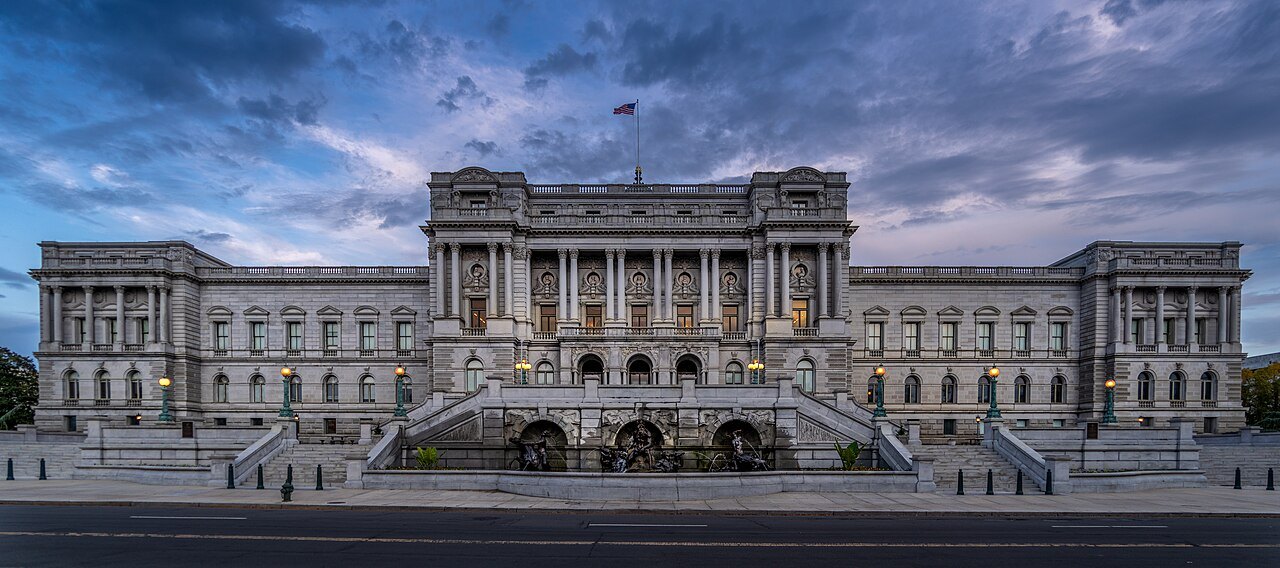
The reason a visitor comes today is the Thomas Jefferson Building, finished in 1897 and still the most elaborate interior in the city. It stands on First Street SE, facing the Capitol's East Front, with the Supreme Court across East Capitol Street; together the three buildings form the sides of the square at the top of the hill.
The library now holds roughly one hundred seventy-three million items across three buildings on Capitol Hill, and functions as the national library in practice, though only members of Congress, their staff and the library's own employees may actually borrow from it.
Jefferson's offer
In August 1814, British forces set fire to the public buildings of Washington, including the Capitol. The small original congressional library, assembled since 1800, burned along with it, leaving Congress without a working collection of its own at the seat of government it had just occupied.
The following year, 1815, Congress accepted an offer from Thomas Jefferson to sell his personal library outright: six thousand four hundred eighty-seven books, built up over decades of his own reading and collecting. That purchase became the foundation of the collection that exists today.
It was a private library turned into a national one by a single act of Congress, and for much of the nineteenth century it defined what the institution held, how it was organized, and how it was expected to grow.
The fire that nearly erased it
The Jefferson books survived for more than three decades until a second fire struck the Capitol in 1851. That blaze destroyed about two-thirds of Jefferson's original volumes, undoing in an afternoon most of what the 1815 purchase had carefully rebuilt from nothing.
The honest number is blunt: fewer than half of Jefferson's books survived that fire. What is shown or shelved today under his name is a remnant of the original purchase, not the whole library he actually sold to Congress.
The collection rebuilt again in the decades afterward, but what grew back was shaped as much by new acquisitions, gifts and deposits as by whatever remained of Jefferson's own shelves, so the modern library is not simply his library enlarged.
From a Capitol room to a palace of its own
Growth accelerated sharply after the Copyright Law of 1870 required every copyright applicant to deposit two copies of the work with the library. Books, maps, music, prints and photographs arrived faster than the Capitol's rooms could hold them, and Librarian Ainsworth Rand Spofford pressed Congress for a building of the library's own.
John L. Smithmeyer and Paul J. Pelz won a design competition in 1873, but Congress did not vote to build until 1886. Smithmeyer was dismissed in 1888 and Pelz in 1892; the architect Edward Pearce Casey and the engineer Bernard Green then completed the interiors that visitors see today.
The building opened on November 1, 1897, and was recognized at once as a national monument rather than a plain working library. It was not formally named for Jefferson until 1980, nearly a century after it opened its doors.
What you see today
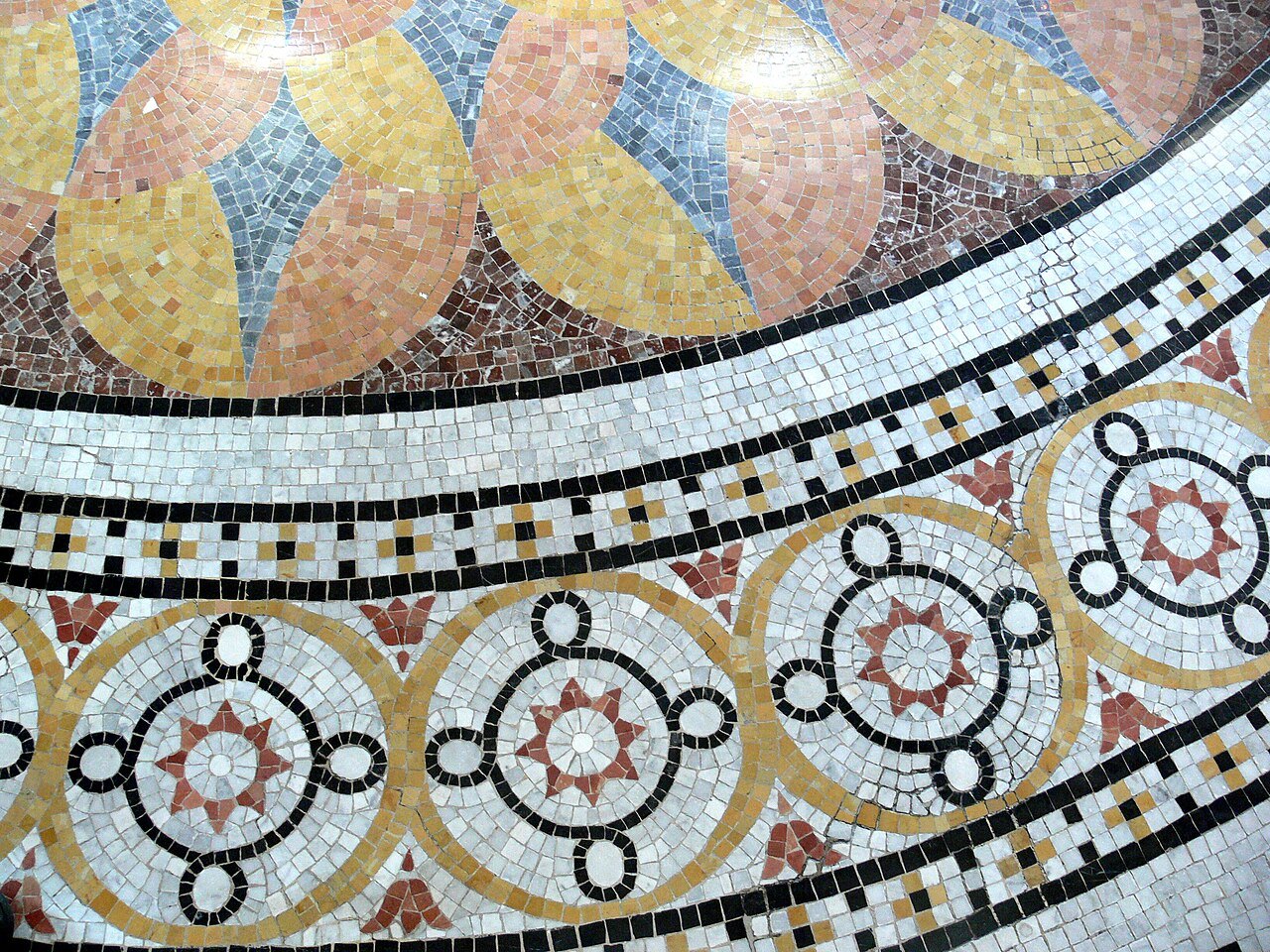
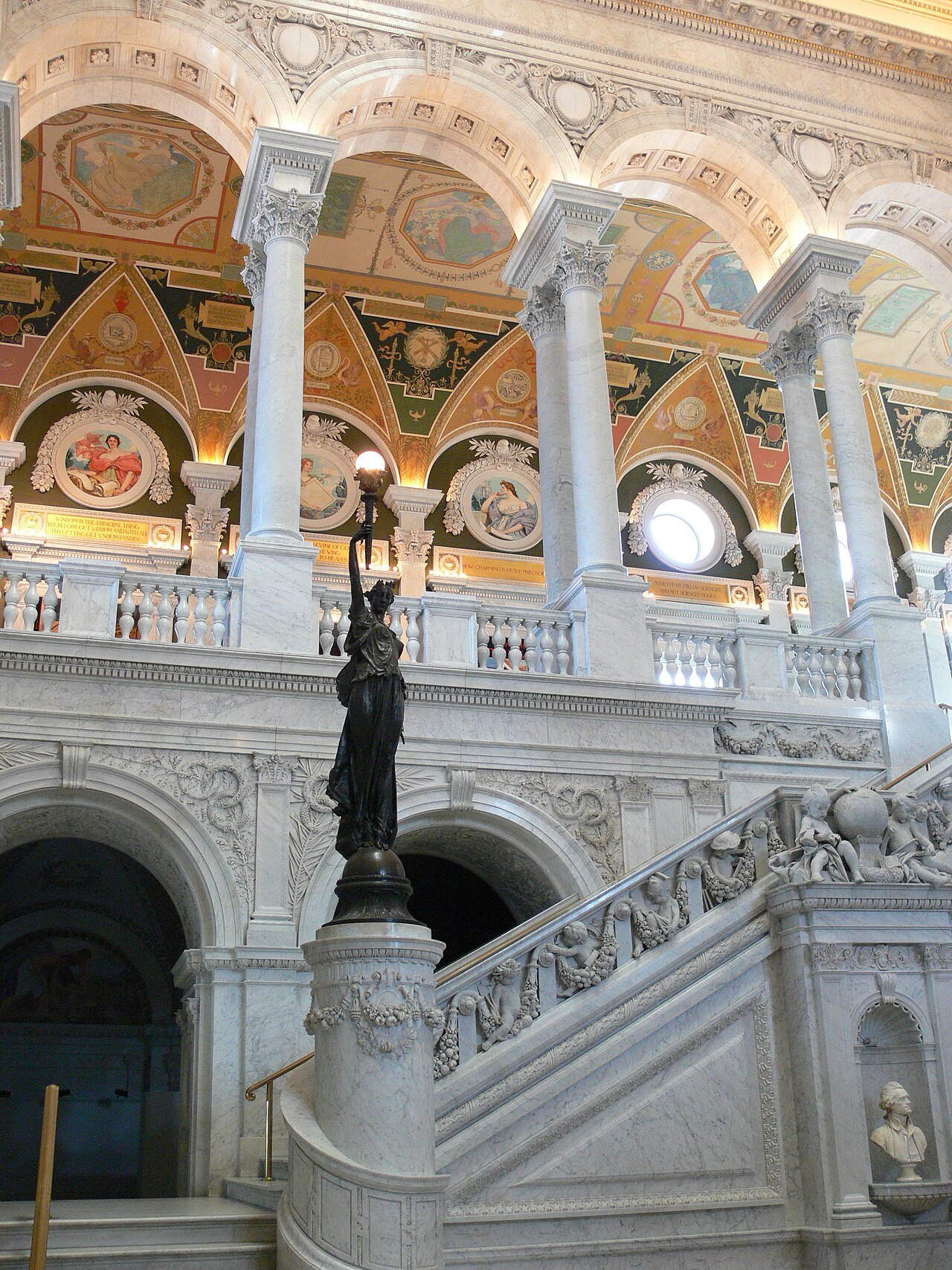
The Great Hall is the entrance: two storeys of marble, mosaic floors, paired staircases and a painted ceiling, with galleries running around the upper level. More than fifty painters and sculptors worked on the building, and almost every surface of the public rooms carries paint, mosaic, carving or an inscription.
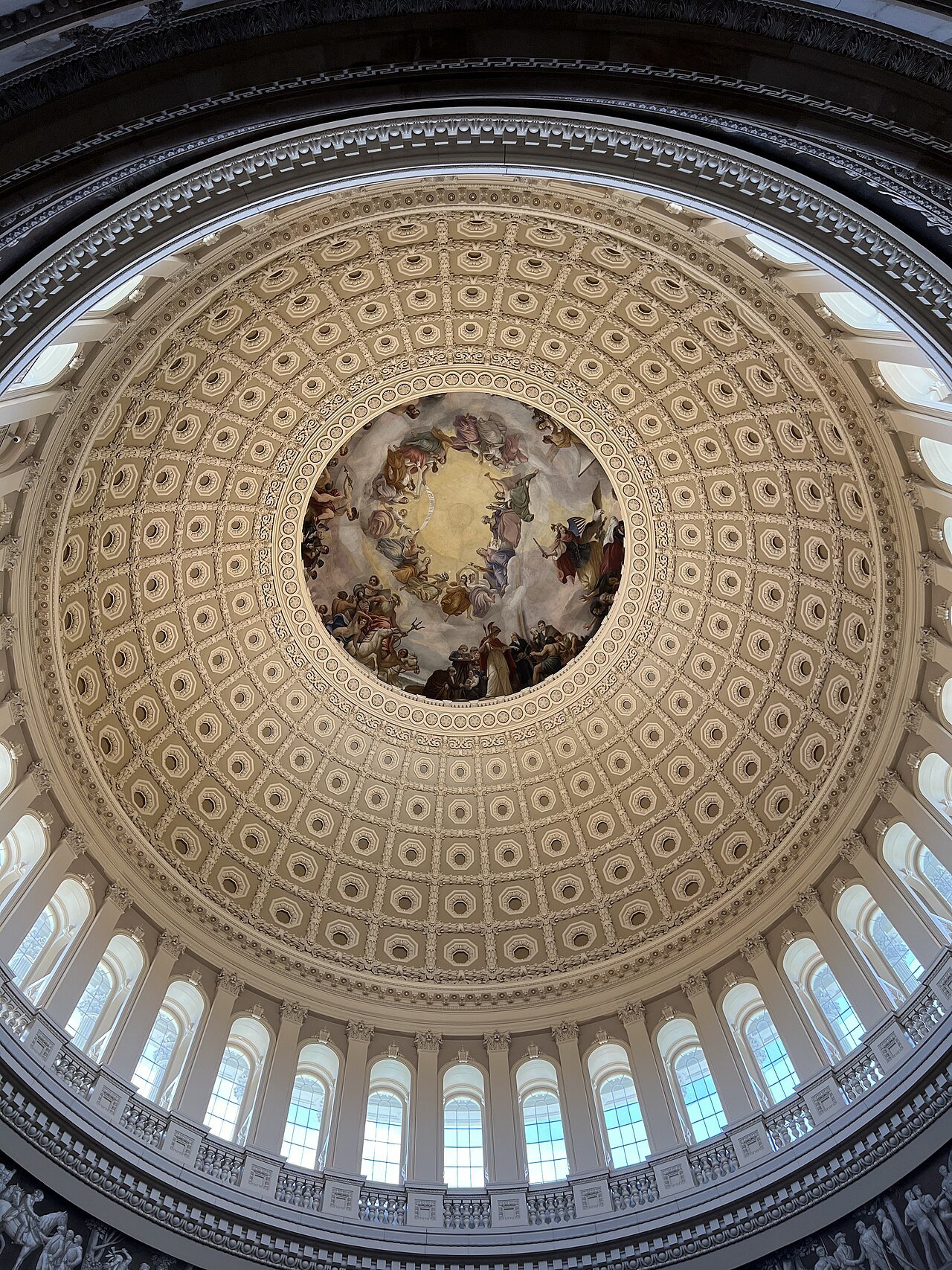
From an overlook on the upper floor, visitors look down into the circular Main Reading Room beneath the central dome, painted by Edwin Blashfield in 1896. At the top, a female figure representing Human Understanding lifts a veil from her face, surrounded by twelve winged figures standing for civilizations and the gift each is said to have made to knowledge.
Around the Main Reading Room, eight marble columns carry plaster figures, and the reading desks form rings around a central catalog desk. Outside, set into the building's west front on First Street, is the Court of Neptune fountain of 1898, Roland Hinton Perry's bronze Neptune among tritons and naiads, a design inspired by the Trevi Fountain in Rome.
Across East Capitol Street stands the Supreme Court Building, designed by Cass Gilbert and built between 1932 and 1935: a white marble temple faced with Vermont stone, its interior lined with Alabama marble and its courtroom finished in ivory-veined Spanish marble with twenty-four Italian marble columns. One justice reportedly said the Court would look like nine black beetles set against that temple.
How to visit
Free timed-entry tickets are required to enter the Jefferson Building. The library's visitor page describes reserving a ticket online up to thirty days ahead, with a further release of same-day tickets made available online each day; check that page directly before planning a visit, including through booking ahead.
Every visitor passes through security screening, and the library warns that lines at screening run longer than usual from March through July. Build that stretch of time into any day that also includes the Capitol or the Supreme Court next door.
The Main Reading Room itself is normally reserved for registered researchers, but the library runs short walk-throughs around its center desk at set times, offering a limited number of free tickets; check the library's own page for the current arrangement rather than assuming entry.
Casual photography is part of most visits, though posed or staged sessions, such as a portrait or wedding shoot, need a permit. Anyone who wants to use the collections, rather than simply see the building, can register for a reader card; the Supreme Court Building follows its own calendar and rules, so check its visitor pages separately before planning around a session.
Honest notes
The Library of Congress is not a lending library for the public, and most of what it holds sits in closed stacks out of view. A visit here is a visit to the building, its exhibitions and the Main Reading Room overlook, not to the shelves themselves.
On the specific question this page is built around: Jefferson's personal library of six thousand four hundred eighty-seven books became the library's foundation in 1815, and fewer than half of those original volumes survived the fire of 1851. What survives today is a fraction of what he sold, not the whole of it.
The name Library of Congress also covers more than one building. The John Adams Building of the 1930s and the James Madison Memorial Building of the 1970s stand next to the Jefferson Building, and the library's holdings are spread across all three.
Read next03
More from the journal
- The United States CapitolWhat is inside the Capitol Rotunda, and who painted its dome?A guide to what fills the Capitol Rotunda, who painted its dome, and how to see both on a free tour.Read the piece →
- Getting AroundHow does the Washington Metro work for visitors?The Metro has six colored lines, 98 stations and fares that depend on distance and time of day, so you tap in and tap out. How to pay, find the right platform, change lines and reach the sights, the airports and Union Station.Read the piece →
- The White House and Lafayette SquareHow do you get a White House tour?Public tours of the White House are free, self-guided and arranged only through a member of Congress, up to six months ahead, with a background check for older visitors. How the request works, what you see, and what to do if you cannot get one.Read the piece →